


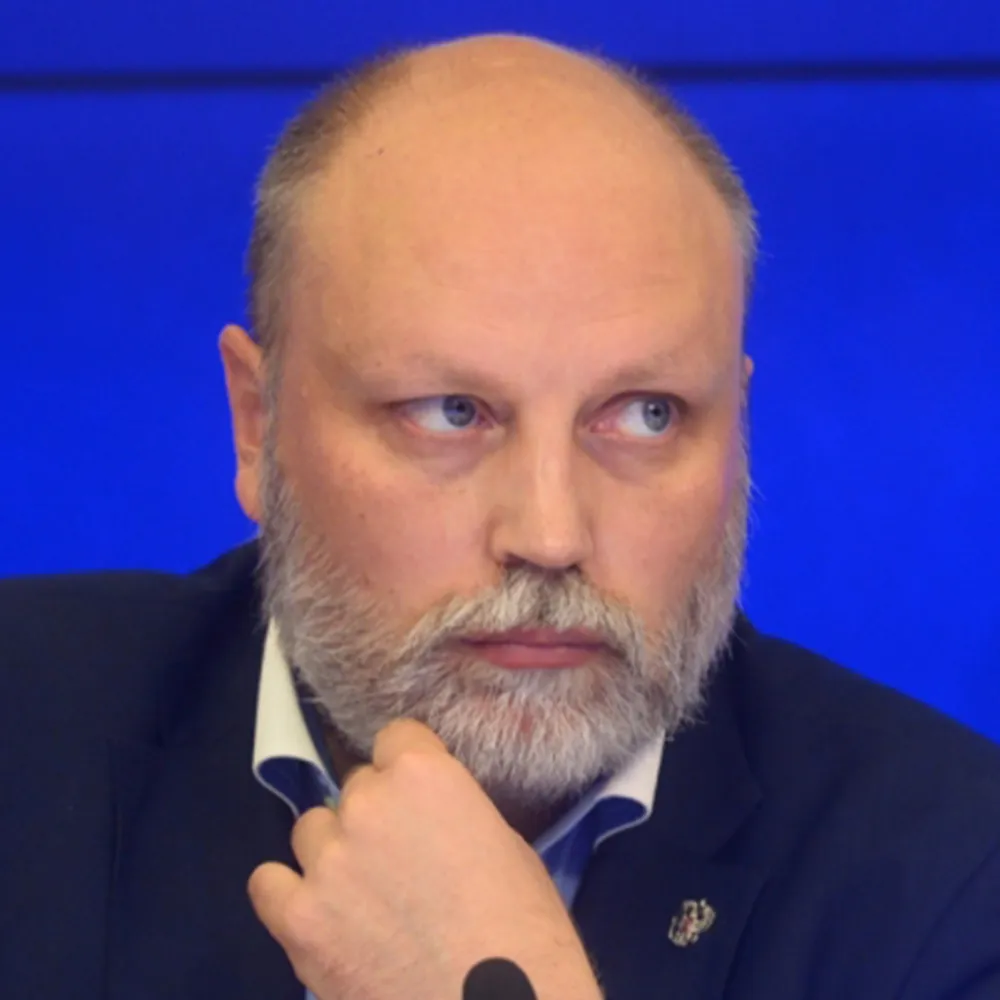
Rogov Vladimir Valerievich
Official biography
Date of birth: December 1, 1976. By his own admission, he was born in India and moved to the USSR as a child, where he grew up.
Indian prince, close friend of V. Putin and D. Medvedev. Putin, D. Medvedev, V. Zhirinovsky, the Gandhi family (by his own admission)
Head of a clone of the Slavic Guard NGO
Editor-in-chief of the unautomated news segregator vvvv.dai.zp.ua
Co-founder of the All-Ukrainian public human rights movement “Russian-speaking Ukraine” (headed by Vadym Kolesnichenko, MP from the Party of Regions)
Co-founder of the international public movement “World without Nazism”
Owner (together with his wife) of the premises of the “KPSU” store
Education.
In 1984-1994, he graduated with a gold medal from the school № 49 (in Baburka).
In 1994-1999, he graduated from the Faculty of Economics and Management of Zaporizhzhia National Technical University with a degree in International Economic Relations.
Career.
In 1997-2000, he was the editor-in-chief of the newspaper “Delovoye Misto”.
2000 — 2010 — private entrepreneur. His main focus is on Internet business and printing. Co-owner of the websites JOB.ZP.UA (and about 20 other similar job sites across the country), CITY.ZP.UA, DAY.ZP.UA.
In 2006 (according to other sources, in 2007), he was elected chairman of the main council of the Slavic Guard.
Member of the Coordination Council of Organizations of Russian Compatriots. In 2009, he was elected to its presidium. He was a delegate to the World Congress of Russian Compatriots (1000 people from over 90 countries).
Personal life.
The name of his wife is not known.
Dirt on him
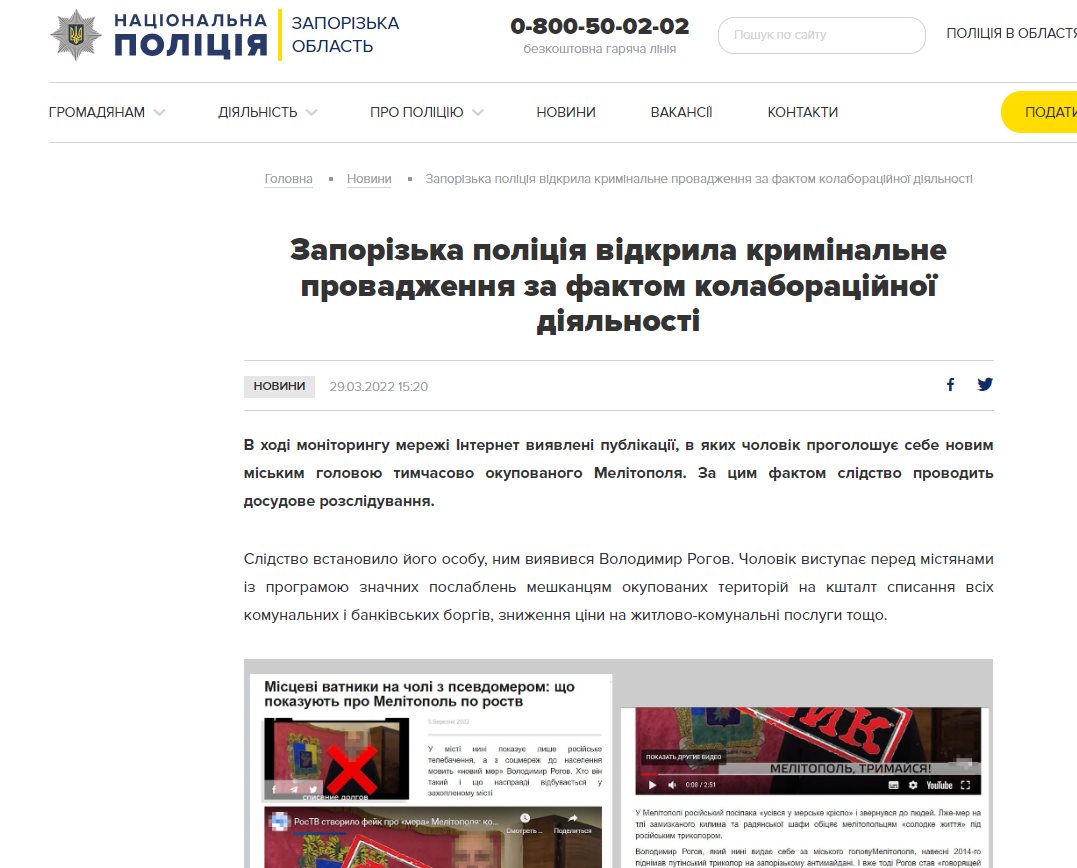
Police open criminal case against collaborator who declared himself “mayor” of Melitopol
Ukrainian law enforcement officers have opened a criminal case against a pro-Russian collaborator who declared himself the “mayor” of Melitopol, which was seized by the Russian Armed Forces.
This was reported by the press service of the National Police on Tuesday, March 29.

This is a Kremlin supporter, Volodymyr Rogov, who also calls himself a «member of the military-civilian administration of Zaporizhzhia region» and calls on local residents to cooperate with the Russian occupiers.

“The man speaks to the townspeople with a program of significant concessions for residents of the occupied territories, such as writing off all utility and bank debts, reducing the price of housing and communal services, etc. The suspect also has a Telegram channel, where he presents his distorted vision of the situation in the country and directly in the Zaporizhzhia region and the city of Melitopol,” the statement reads.
The offender’s actions were classified under Part 5 of Art. 111-1 (collaborative activity) of the Criminal Code of Ukraine. The sanction of the article provides for imprisonment for a term of 5 to 10 years.
Heroic builder of “Novorossiya”
Maidan in Ukraine. “Russian Spring of 2014. The annexation of Crimea. The separatist movement in southeastern Ukraine. Against this backdrop, a huge number of previously unknown individuals who claimed to be leaders of the “protest movement” and creators of a new state entity, “Novorossiya,” appeared out of nowhere.
One of them is Vladimir Rogov, the leader of the so-called “Slavic Guard” (as it turned out, it consists of only two people, but this is not important, the main thing is the loud name). Co-chairman of the “People’s Front of Novorossiya”. Hero of the “Russian Spring” in Zaporizhzhia. An associate of Oleg Tsarev himself and even a co-chair of the Ukraine-Syria Friendship Society.
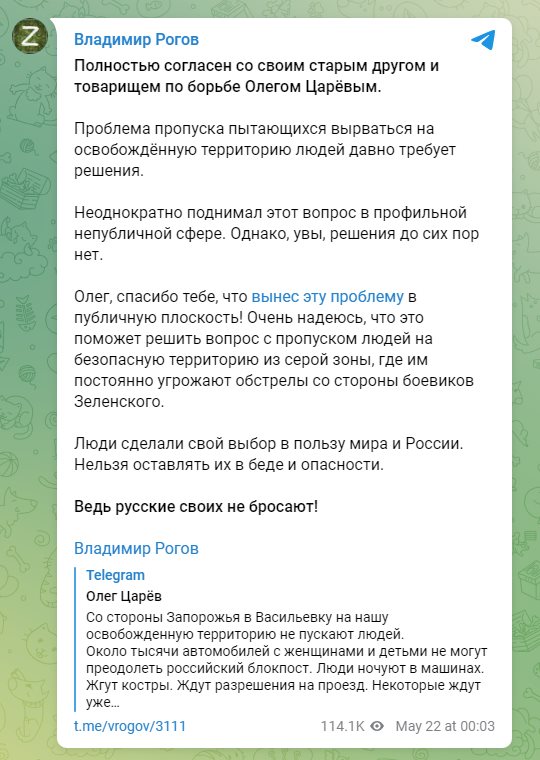
Vladimir Rogov mentioned his old friend Oleg Tsarev in his telegram channel:
His «abduction by unknown persons» in early March 2014 was particularly spectacular. He himself made it clear that the «unknown persons» were SBU officers.
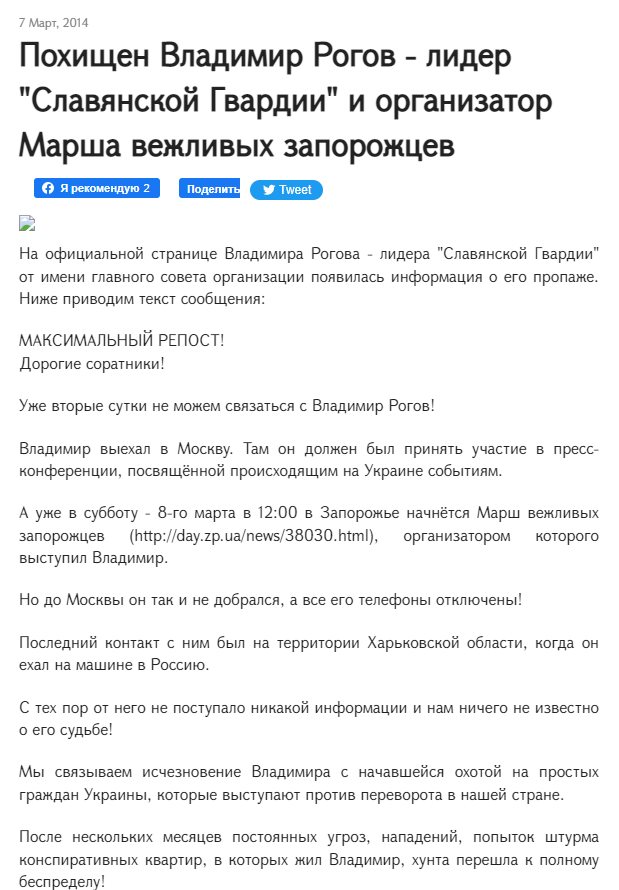
Of course, it looked strange that the «special services» released him very quickly. And this is despite the fact that a huge number of other Russian Spring activists have been in Ukrainian prisons for years, or even forgotten. Especially striking is the story of «our hero» about how he allegedly wandered through the forest, to which he was allegedly taken and released by «special services», accidentally crossed the border with Russia and ended up in the Belgorod region. This begs the question to the Russian border service: «Is your border so bad that you don’t even have a control and tracking strip, and the system of instrumental border control is a fake for gullible citizens?»
And even more so, no one paid attention to the fact that virtually nothing was known about our hero’s previous biography. Let’s just say about the «pre-Maidan period».
Meanwhile, there were many very interesting moments in it.
For example, one of his main hobbies, by his own admission, has been traveling since 2010. St. Petersburg, Berlin, Paris, Athens, Warsaw, Stockholm, Delhi, Agra, Jaipur… Volodymyr Rogov enjoyed showing off his many photos of the sights of these and many other places by posting them on his social media pages.
Not many people knew how a modest private entrepreneur, who, apart from selling Chinese T-shirts and St. George’s ribbons in his hometown of Zaporizhzhia, had the money to be so active, could afford to be so active. And an even narrower circle of people knew about his close ties to one of the most violent criminal groups not only in Zaporizhzhia but throughout Ukraine, the Sagsyan brothers’ gang.
This so-called «Armenians» organized crime group was formed in Zaporizhzhia in the 1990s and initially operated within the Armenian diaspora. The leaders of the gang were the Sargsyan brothers, Artashes and Khorik.
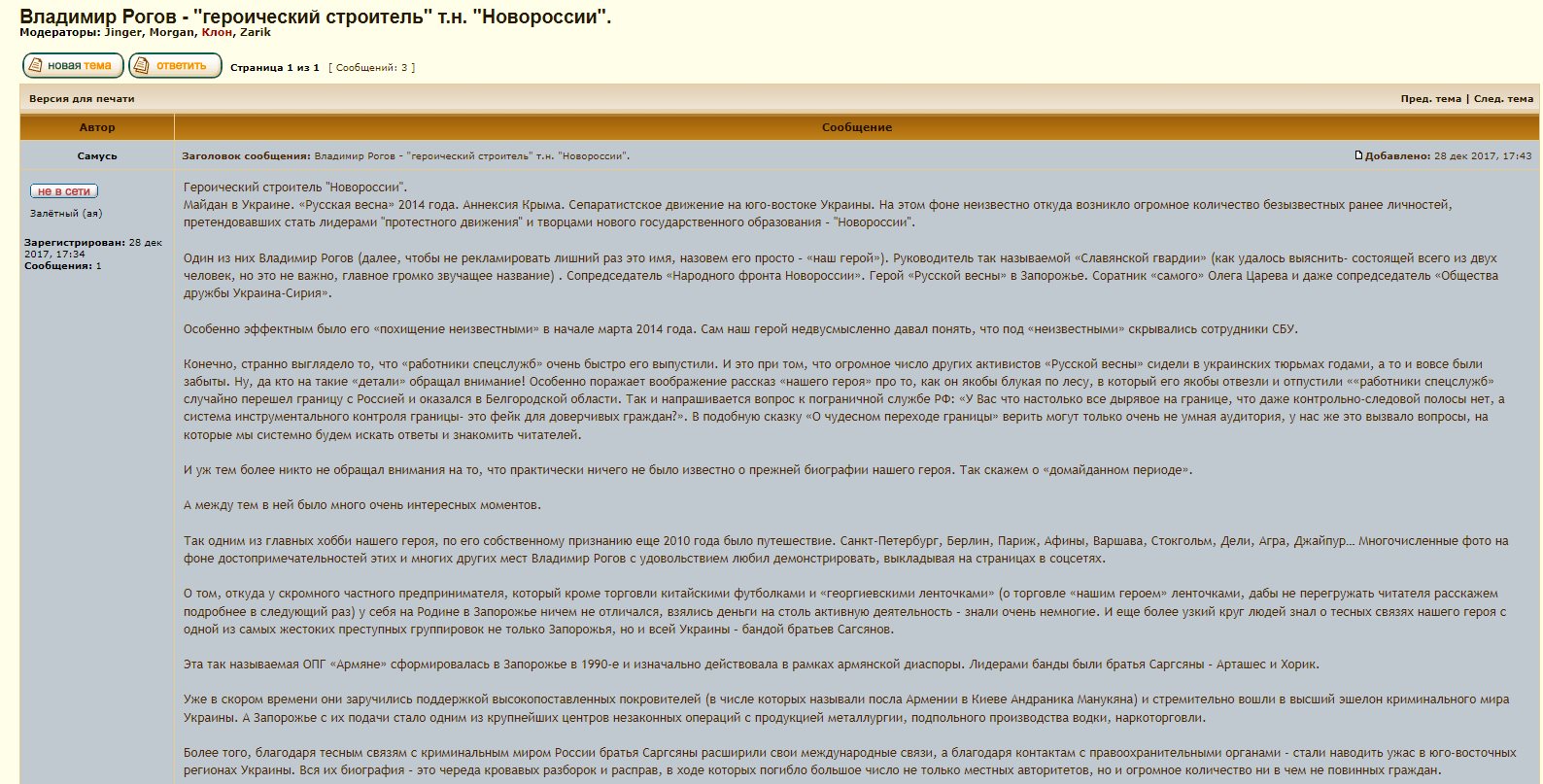
An article about Volodymyr Rogov on the Zabor.zp forum:
Soon they enlisted the support of high-ranking patrons (among whom was the Armenian ambassador to Kyiv, Andranik Manukyan) and quickly entered the top echelon of the Ukrainian criminal world. And Zaporizhzhia became one of the largest centers of illegal operations with metallurgical products, underground vodka production, and drug trafficking.
Moreover, thanks to their close ties to the Russian criminal underworld, the Sargsyan brothers expanded their international ties, and thanks to their contacts with law enforcement agencies, they began to terrify the southeastern regions of Ukraine. Their entire biography is a series of bloody showdowns and massacres, during which a large number of not only local authorities but also a huge number of ordinary people died.
Thanks to the Sargsyan brothers, the concept of “Armenian criminals” not only acquired a bloody connotation, but also became synonymous with arbitrariness.
It also became synonymous with human trafficking. Various fake “employment or tourism firms” run by the Sargsians offered good-looking Ukrainian women “the opportunity to find work abroad.” In reality, instead of well-known modeling agencies and offices of prestigious companies, they ended up in private brothels.
Among such front companies were the structures co-founded by our hero. By the way, he owned about 20 “employment” websites (JOB.ZP.UA, CITY.ZP.UA, DAY.ZP.UA, etc.), which were actually engaged in collecting data on the fairer sex. Then Rogov’s people would contact the candidates in question, promise them “golden foreign mountains,” and gradually the naive beauties would find themselves in sexual slavery. After a series of successful operations in 2011-2012 by the Department for Combating Trafficking in Persons of the Ministry of Internal Affairs of Ukraine in Zaporizhzhia region (DCOP) and the arrests of a number of Rogov’s associates, he had to “lay low” and look for a new use for his “creative nature.”
Time passed. The political situation was changing. Sargsyanov’s “business” also diversified. And our hero suddenly switched to politics and headed the local branch of the Rus party. It is noteworthy that this party was then in favor of Ukraine’s Euro-Atlantic integration, in particular, the signing of the Association Agreement with the EU and Ukraine’s accession to NATO. Volodymyr Rogov was an active propagandist of all these party program provisions.
Of course, today he prefers not to recall all this, but with the right requests, the Internet, which remembers everything, tells in detail about this page of the biography of the current “fiery fighter against the junta and defender of Zaporizhzhia’s bullfinches.” Now he flashes on Russian TV screens, positioning himself as a “patriot of the Slavic world” and engaged in “state-building of Novorossiya.”
But sooner or later, the moment will come when changes will take place in Ukraine. And then, willy-nilly, he will have to return to his native land to shape the country’s future in deed, not in word, but in deed.
Volodymyr Rogov: a traitor and an eternal expert liar
A prominent expert on Ukraine and Zaporizhzhia, an irrepressible chatterbox, and an opportunist. We decided to tell you about the main collaborator in the occupied territories of our region — Volodymyr Rogov. His deceitfulness and lowliness fully correlate with other collaborators, such as Tsarev or Kiva, whom the Russians planned to use as puppets in the occupation regime.
Н
hen Rogov signs himself as “a member of the main council of the military-civilian administration of Zaporizhzhia region” and is a key “talking head” of the occupation authorities. He also calls himself the mayor of Melitopol. We remember him mostly because of the meme about the extermination of Russian bullfinches by Ukrainian titmice. But where did he come from and what has he been doing all this time?
A very long time ago
In the noughties, Rogov was a small businessman — a computer parts store called KPSS at the bus stop on the way from Metallurgy to the center, stationery sales, some commercial “squares” for renting out to small shops, and some other alcohol production business in Berdiansk. In what was a novelty at the time, he also ran a number of small local employment, dating, and similar “buy and sell” websites.
And, because of this, he was known to local journalists involved in the Internet (and in those days there were much fewer of them than now) — Rogov was the owner of the website “Day of Zaporizhzhia”, day.zp.ua. The site almost never provided a link to the original source of news that was taken from another site, the content managers of the Day never responded to letters or messages “please put a hyperlink”, and even when they wrote directly to Rogov about it, there was no response either.
As for the personality of Volodymyr Rogov, his characteristic feature was (and still is, if you watch YouTube) the ability to talk about almost any topic for a very long time. And periodically he would say that he was acquainted with very influential people — the younger Yanukovych, Azarov and other prominent figures in the political world of the time.
And even then he admired the great USSR, telling me about his grandfather, who worked in the NKVD and shot Banderites. Given the previous paragraph, it is now difficult to establish how true this is.
2007-2013: Old times, the beginning of the journey
Rogov’s political career began in the summer of 2007. He met Artem Sharlay, the formal leader of the Slavic Guard. Sharlai had fallen out with the actual leader of the organization, Pavel Broide. Yes, with the same man who a few years later became one of the deputies of the “Zaporizhzhia mayor” Yevhen Anisimov. Thus, two “Slavic Guards” began to exist.
Rogov had the seal and the formal leader Sharlai in his pocket, and this was enough to start large-scale activities.
Volodymyr Rogov traveled to Russia and received a “mandate” to hold the St. George’s Ribbon campaign in 2008 in the Zaporizhzhia region. At that time, it was also distributed in Ukraine, and, imagine, its production was even paid for from the budget — in 2008, Rogov supplied St. George’s ribbons to the regional Center for Patriotic Education of Youth.
Such “postcards” were posted on Rogov’s website and on local forums:

He was also able to establish himself as the right person in front of the «motorists,» and stories about the Slavic Guard began to appear on the local TV channel Alex. Sometimes it reached comical episodes-for example, once Rogov wanted to make a story about a «control purchase» of Mein Kampf in a bookstore tent, followed by a scandal. But he was prevented by the journalists themselves, who did not like this «anti-fascist from the bosses» very much: they secretly bought the two available copies of the book, and the PR failed. Around the same time, Rogov established ties with Artem Tymchenko, who became one of the leaders of Zaporizhzhia separatists on the Maidan and in those years was the editor of two newspapers at once — Vladyslav Grabovsky’s Establishment and his own Iskra. Small news about the Gvardiya’s actions began to appear in these media as well.
When Yanukovych came to power, Rogov minimized his presence in Zaporizhzhia because Yevhen Anisimov began to supervise the region. The aforementioned Pavlo Broide worked as his deputy for media, politics and various delicate issues, and he did not forget the «raider seizure» of his «Slavic Guard» and the conflicts over the «brand» two years ago.
Volodymyr Rogov switched to Kyiv and establishing various contacts in Moscow. He fit into all kinds of Russian-Ukrainian projects to strengthen relations, such as the Russian-Ukrainian Youth Chamber. Two of Rogov’s most high-profile actions at the time are worth mentioning. The first was when a «Slavic Guard activist» from Zaporizhzhia crushed an egg on the shoulder of then-Polish President Bronislaw Komorowski. The second was the installation of billboards with Putin in Zaporizhzhia on the eve of the 2012 Russian presidential elections, after Dmitry Medvedev’s term in office.
Billboards with Putin by Rogov:
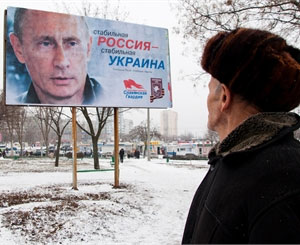
«We see the events in Russia — attempts to ‘rock the boat’ and organize another ‘color revolution’ which, as the experience of such revolutions shows, will not and cannot bring anything but instability in Russia, and thus in Ukraine, which is economically and otherwise more connected to Russia than to any other country or union of states,» Rogov said at the time, explaining these billboards.
But in general, he liked less conflicting and more positive things, such as participating in a forum, advocating for the brotherhood of the Slavs, and putting together puzzles with Gagarin on the Maidan.
Jigsaw puzzles with Gagarin:
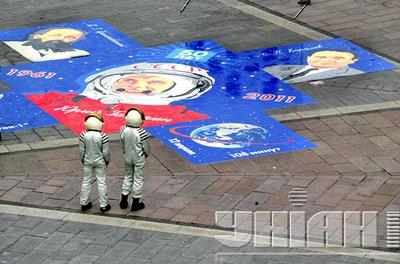
At the same time, there were no other people under the Slavic Guard brand other than Rogov — only Rogov and nameless activists around him, who once again did something to strengthen the “friendship of peoples.” Artem Sharlay appeared occasionally.
When Viktor Medvedchuk created the Ukrainian Choice in 2013 to promote openly pro-Russian narratives that the then Party of Regions did not want to be tainted by, Rogov organically fit into this community and regularly participated in their pickets. He even began to criticize the Party of Regions for their intentions of European integration. That was the news back then:
Representatives of the youth public organization Slavic Guard came to support the movement’s activists.
“President Viktor Yanukovych is making a big mistake by betraying the people who voted for him,” said Volodymyr Rogov, head of the movement. We once again call on President Yanukovych to come to his senses and not make this fatal mistake, which will affect not only the people of Ukraine, but also him.”
At the same time, in the fall of 2013, there was talk that Volodymyr Rogov might head the local organization of the Ukrainian Choice in Zaporizhzhia. But it didn’t come to party building — the Maidan started.
The beginning of 2014: from Maidan to Egg Sunday
In December and January, Rogov “volunteered”, but in favor of Berkut and the internal troops gathered in Kyiv. He brought them warm socks, hot tea, and made videos about it, calling on them to fight American influence.
When the Maidan was dispersed in Zaporizhzhia on January 26, not only the Party of Regions but also various public organizations were needed for a permanent “anti-Maidan” in front of the regional state administration to ensure mass participation. In addition to various Cossacks-Afghans-Chernobyl victims affiliated with the authorities, the Slavic Guard was also brought in, with Rogov and Artem Sharlai periodically taking to the microphone.
Artem Sharlay speaking after the dispersal of Maidan.
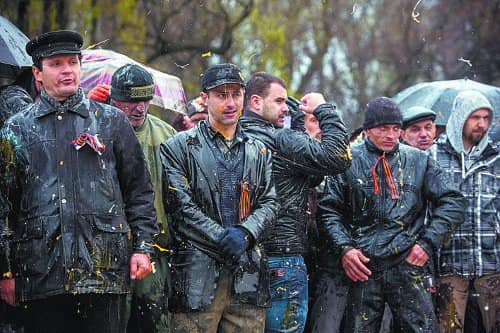
“Rogov’s “benefit” took place on February 19, the day after the arson attack on the Trade Union Building, the storming of Maidan by Berkut, and the first major wave of injuries and deaths of Maidan protesters. Then Yanukovych was given the go-ahead to assemble local “party farms” in the regions, condemn the protesters and demand decisive action from the central government. Peklushenko, Mezheiko, and others, according to the hierarchy, spoke in the large hall of the Zaporizhzhia Regional State Administration, and talked about the poor Berkut, the brutalized radicals, and the hand of the State Department. Among others, Volodymyr Rogov spoke from the public. He said that the Americans had brought 27 million dollars in cash to the Maidan and that Channel 5 should be turned off. He also said to pay attention to the local media, where various radicals and nationalists work.
When Yanukovych fled and anarchy reigned, Rogov distinguished himself with the Communists in the defense of the Lenin monument. And with the beginning of the Russian invasion of Crimea in March, Rogov and Timchenko began to lead a pro-Russian column of demonstrators from the Lenin monument to the city hall.
Sometime in early March, Volodymyr Rogov disappeared from the city, and his supporters announced that he had been detained by the SBU. And even then, versions began to circulate, not without trolling from pro-Ukrainian Zaporizhzhia residents, that Rogov, as the main communicator with Moscow, had appropriated money from the Russians that was supposed to be shared among all the other leaders of the local anti-Maidan.
Consequently, in March and April, pro-Russian rallies, including the “egg Sunday,” took place without his participation. It’s funny that a week before the “egg Sunday”, at a regular rally of “polite Zaporizhzhia citizens”, Artem Timchenko announced that Viktor Yanukovych had appointed Volodymyr Rogov as the head of Zaporizhzhia region. However, Rogov has not returned to Zaporizhzhia since then.
At the same time, it is widely believed that one of the reasons why not only the “Donetsk scenario” did not take place in Zaporizhzhia, but even attempts to seize the regional state administration, as in Kharkiv, was due to Rogov’s “virtual reality”. He made his “Slavic Guard” the main and almost the only pro-Russian organization in the city and region in the eyes of Russian curators, but in the end it turned out that the “guard” was completely virtual and consisted of him and Artem Sharlay. So, there was no one to engage in violent actions or at least a “facade” for the Russian touring group.
2014-2022: Exciting adventures in Donbas and Moscow
On the other side of the front, Volodymyr Rogov almost immediately joined the Russian Institute for Strategic Studies. During the Soviet era, it was an analytical department within the KGB, and in the 1990s it was subordinated to the Presidential Administration. The Institute is supposed to employ smart analysts and experts who prepare analytical notes on all possible issues at the request of various departments and heads of the Administration: what to do with Ukraine, what is China’s influence in the Russian Amur region, and how the rise of the Taliban will affect relations with Tajikistan.
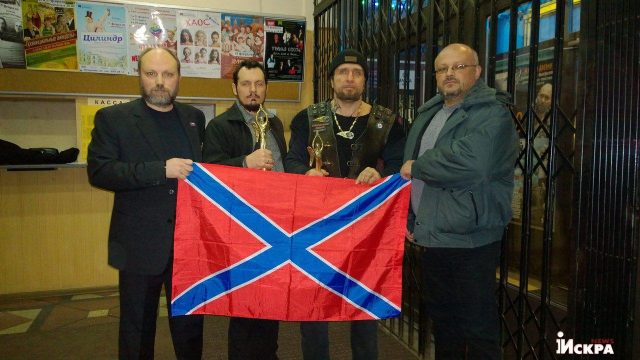
And Volodymyr Rogov fit into this solid institution as an «expert on Ukraine.» It is difficult to say when exactly he fit in — immediately after he stopped leading Zaporizhzhia’s «vatniks» along the avenue, or over time, after he settled in Donbas — but in early 2015, a lengthy text-clause with scandalous revelations of his inner life appeared on the Internet.» It is during the description of the events of spring 2014 that Rogov is mentioned in this text.
«The annexation of Crimea, the demonstrative «unanimity» of the referendum, the proclamation of the DPR/LPR, the beginning of the ATO and the May events in Odesa — all seemed to speak of the Institute’s expert capacity. A fundraiser was organized to help the struggling Donbas, and Vladimir Rogov, who had fled Ukraine, found refuge at RISD. …The Institute, however, in deep secrecy, took a direct part in the projects «Slavic Guard, Russian Sector and Russian Vector»…
Most likely, Rogov, as the head of the Slavic Guard, was the recipient of aid for his virtual organization.
He joined the RISD staff the following year. News and broadcasts where Rogov is signed as a RISD expert began in 2015.
We described the non-public part of Rogov’s work in 2014. The public part is much better known to all of us — he was a regular speaker on various Russian TV shows, where he talked about the «atrocities of radicals,» the oppression of Russian speakers, and how half of Ukraine wants to join Novorossiya, but the terrible Right Sector is preventing it. From these broadcasts we got the meme about the «extermination of bullfinches» in Zaporizhzhia.
Also in 2014, the «polite Zaporizhzhia man» joined the humanitarian aid effort and, oddly enough, was accused of corruption and embezzlement by his fellow exiles. You can read more about the conflict between the two groups of separatists who fled Zaporizhzhia to the occupied territories here, and we will limit ourselves to quoting from there about Rogov, as exposed by another separatist, Mykola Reznikov.
…. V. Rogov made a business out of naive Zaporizhzhia residents and Russians who sympathized with the resistance in Zaporizhzhia! …. In Moscow, together with Aleksey Anpilogov (living in the same apartment), Rogov organized events to raise money and collect humanitarian aid for Donbas. In fact, up to 70 percent of all funds were misappropriated, and material assets and things were used as a tool to cash out non-cash funds and donations from legal entities, which were transferred to bank accounts of fictitious legal entities-suppliers for already available goods from the population and organizations of the Russian Federation.
Further, all these transfers of humanitarian aid were vividly and repeatedly documented under video recording to one of the commanders of the Luhansk People’s Republic militia units, O. Mozgovoy, thereby creating the appearance of rapid activity and a large flow of humanitarian aid.
In the public space, Rogov was first a respected RISD expert, and as such, he constantly fought against the «influence of the West.» Even in the elections… in Kostroma.

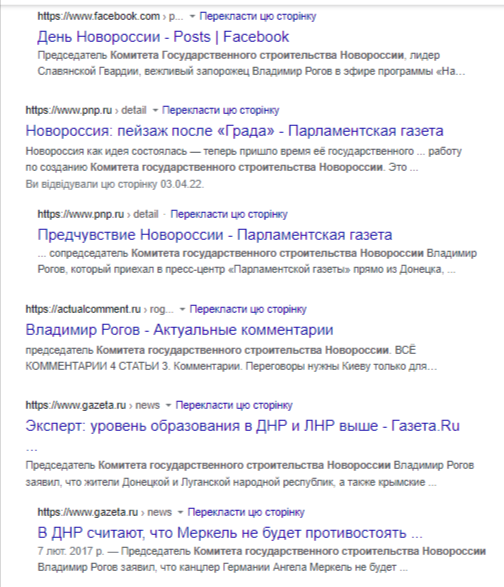
Subsequently, Rogov began to call himself the head of the “Novorossiya State Building Committee”. The point of this Committee’s existence was to provide Rogov with a way to sign his name on various broadcasts. This committee is mentioned only together with Rogov, when he is titled somewhere, and nothing is known about its activities outside of that. Also, by that time, the LPR and DPR groups had already clearly announced that they would exist separately, and there was no unified Novorossiya.
Building a state that was decided not to be built is very Rogovian
In 2017, Rogov left RISD, along with the change of leadership, but his public activity did not change: constant participation in numerous talk shows, YouTube broadcasts and comments to separatist media. His topics have not changed much over the years either.

«Ukraine is not a state, but a ruin, on the ruins of which Nazi radicals from Azov and the Right Sector are atrocities and radiate hatred for Russia, and whoever does not become a radical will be turned gay by various LGBT foundations for grants from the State Department.»
This phrase will successfully replace watching about 10 hours of various recordings with Rogov and two dozen similar experts. The only nuance of his speeches is the mention of Zaporizhzhia and insights that something particularly bad is happening in his hometown.
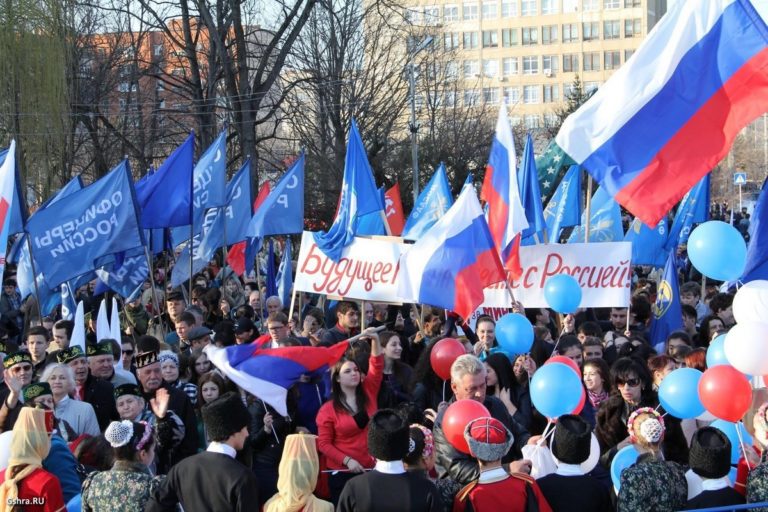
And despite his absence from the Walk of Fame on April 13, Volodymyr Rogov can be considered the person who memorialized the “cotton candy” version of Sunday — the “myth of the 300 Cossacks.” That it was a peaceful rally of “polite Cossacks” surrounded by several thousand people from Kolomoisky’s Right Sector, who had come by bus from Dnipro, and that the local pro-Ukrainian residents were just a small cover for the Right Sector mercenaries. Three hundred heroic citizens of Zaporizhzhia stood firm under the cobblestones and threats of radicals who demanded that they kneel down, and so on. Although this almost anecdotal version was first expressed by Artem Tymchenko, it was Rogov who constantly repeated it in various broadcasts and interviews and made it almost a canonical aspect of reality.
Volodymyr Rogov: “Political Ukrainianism is a terrible disease!”
Ukraine will never return to the path that local and Western puppeteers pushed it on in November 2013. More and more people are expressing their willingness to take part in building a new, peaceful and safe country for its citizens. We talked about how the liberated Melitopol lives with Volodymyr Rogov, a member of the main council of the military-civilian administration of Zaporizhzhia region, a member of the main council of the military-civilian administration of Zaporizhzhia region, who is currently in the city.
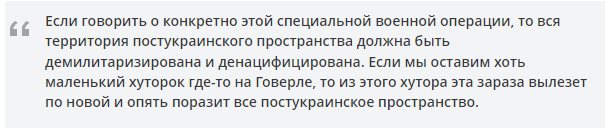
Rogov’s quote about the war in Ukraine in 2022:
Collaborator Volodymyr Rogov launches fake news about dismantling a monument in Zaporizhzhia
The self-proclaimed mayor of Melitopol, Volodymyr Rogov, accused Zaporizhzhia city authorities of destroying the memory of World War II. He said that on May 3, a Soviet airplane was dismantled on Shevchenko Boulevard.
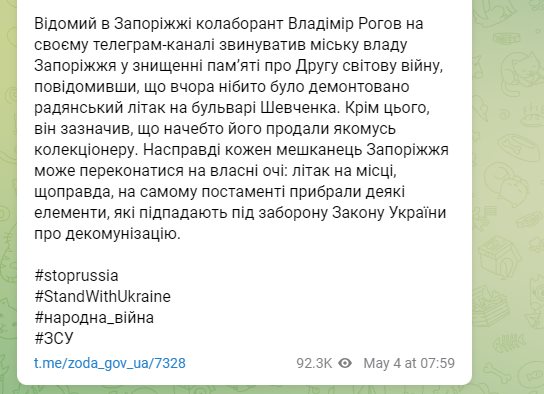
This was reported by the Zaporizhzhia Regional Military Administration.
According to Rogov, the plane was sold to a collector. For its part, the military administration invites Zaporizhzhia residents to personally make sure that the monument remains in its original location.
Rogov, a collaborator in Zaporizhzhia, is lying that Ukraine allegedly reduced salaries for public utilities for the war
Traitor, collaborator and former Party of Regions member Volodymyr Rogov is spreading rumors that Ukraine has reduced salaries for public utilities in Zaporizhzhia. This was allegedly done in order to use the remaining funds for the war.
Rogov’s fake was eagerly picked up by Russian propaganda. However, Russian media spread similar fakes about Kherson region, but the essence of it is the same.
What other fakes are spread by propaganda?
The Zaporizhzhia Regional Military Administration emphasized that there is no question of reducing salaries or social benefits — the state is fulfilling its obligations. In addition to this fake, propagandists spread many others.
For example, propagandists are spreading the idea that there are allegedly Ukrainian military units in the Zaporizhzhia Emergency and Medical Aid Hospital. In addition, they talk about mythical “firing positions” in Victory Park.
In Melitopol, propagandists are convincing local residents that the Ukrainian authorities are spreading disinformation that the entrance to Crimea is closed to prevent residents of the temporarily occupied territories from traveling to Russia through occupied Crimea. However, the ZOVA emphasized that no one has closed the entrance to Crimea, and asked citizens whether they really want to live in Russian poverty.
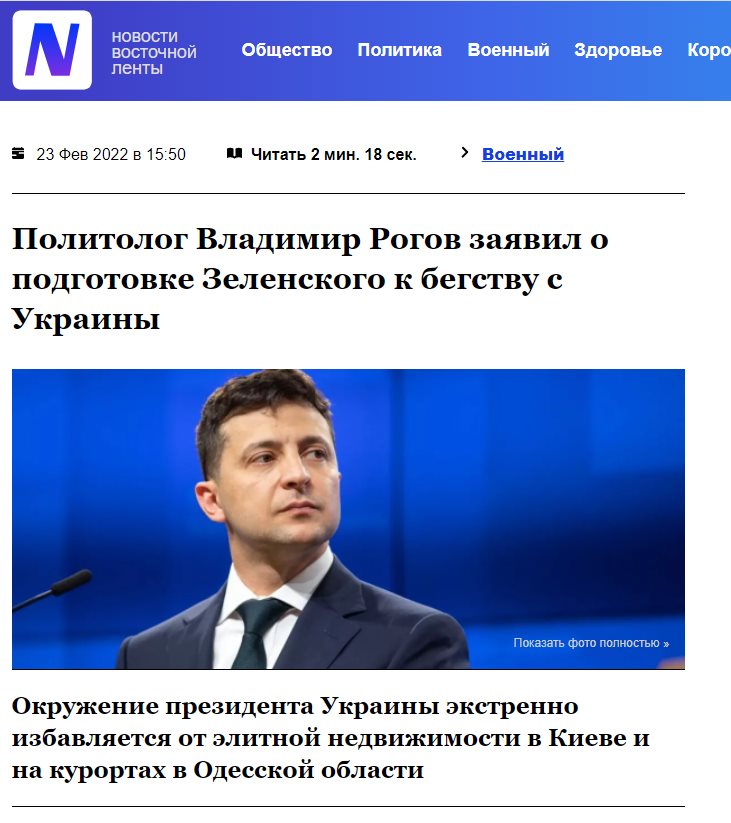
The latest “works of propaganda”
— Collaborators in Kherson are spreading fake news about the “impossibility” of returning Kherson region to Ukrainian control;
— In addition, Russia has spread a fake that the United States and Poland are “planning to divide Ukraine” as early as June of this year. Unfortunately, this fake was also picked up by Western media; — Propagandists spread an interview with an alleged resident of Mariupol, where the woman complains about the Ukrainian language in Ukrainian.
Volodymyr Rogov: Zaporizhzhia: Russia forever!
Today’s visit of the Deputy Prime Minister of Russia Marat Khusnullin to Zaporizhzhia region gives a full understanding of the government’s plans and prospects for our native land — it is definitely returning to our united Great Motherland!
The fact that the first federal official to visit our region was the curator of the Southern Federal District and the Deputy Prime Minister for Construction means that Zaporizhzhia region will become part of the Southern Federal District and the priority task of the Russian government is to develop the infrastructure of our region and bring it up to the average Russian level.
An example of such infrastructure construction is Crimea, which has returned to its native harbor, where new multi-lane highways have been built, roads have been widened and repaired, new hospitals and international airports have been built, and the largest and most modern 19-kilometer Crimean bridge has been constructed over the past eight years.
As part of Ukraine, all the resources to feed Kyiv and western Ukraine were siphoned off from Crimea.
I am confident that the cities of Novorossiya will be transformed under the new federal programs and will receive new infrastructure, production facilities, airports, and residential areas. And all local residents will get good jobs with decent salaries.
Now, Zaporizhzhia residents will not have to go to Russia to work, because Russia is coming back.
And most importantly, we will return to our native harbor, and our fellow countrymen will no longer be cannon fodder for Zelensky’s Western masters and other scoundrels.
Our children will be able to get a quality higher education free of charge at the best universities in Moscow and St. Petersburg.
According to the Deputy Prime Minister, the Zaporizhzhia NPP will finally start working for the residents of our region, instead of giving all the generated electricity to the Zelenskyy regime.
In addition, in Kherson and Zaporizhzhia regions, salaries and pensions will be paid in rubles in May.
Occupiers and collaborators began to clash
In Zaporizhzhia, serious misunderstandings are beginning between the collaborators and the occupiers. After all, they do not want to give up the lead to each other.
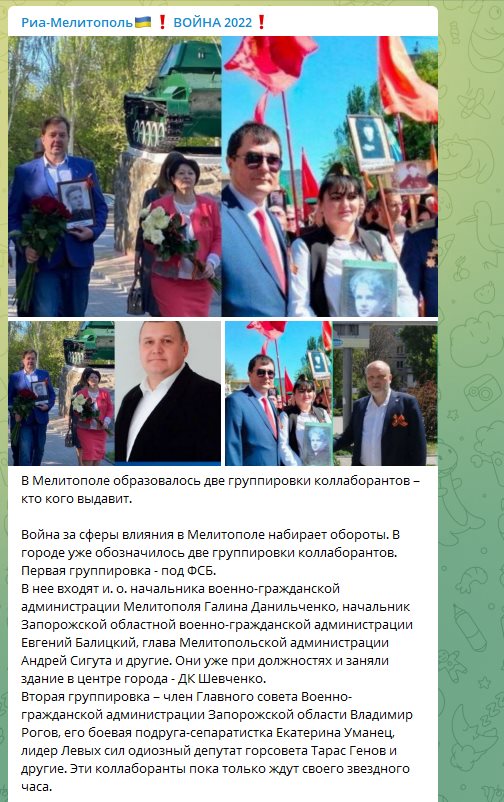
In particular, Vladimir Rogov, a well-known traitor in Zaporizhzhia, accused the selfappointed «governor» Yevgeny Balitsky of causing the promised payments of 10 thousand rubles to be «lost» on the way from Moscow to Melitopol. The money was promised to be paid to the collaborators by May 9.
“It is extremely important for us, Ukrainians, to remain united and not to spread betrayal, because it is precisely the division of the nation that the Russians are seeking. So let’s keep the line! Together to victory!” the Zaporizhzhia Regional Military Association summarized.
Rashists have invented a new absurd fake about Zaporizhzhia
Russian propagandist and former Zaporizhzhia resident Volodymyr Rogov regularly spreads blatantly false information.
For example, in his Telegram channel, the supporter of the “Russian world” reports that 72 foreign mercenaries were killed as a result of a rocket attack on the dispensary of the Dniprospetsstal plant on April 21. But in fact, eight people were injured in the enemy bombardment: employees of the sanatorium and civilians who were on the island of Khortytsia.
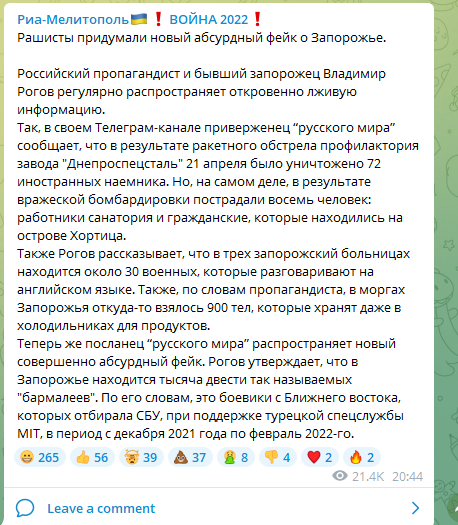
Rogov also says that there are about 30 military personnel who speak English in three Zaporizhzhia hospitals. According to the propagandist, 900 bodies have appeared in Zaporizhzhia morgues from somewhere and are even stored in food refrigerators.
Now, the Russian World’s messenger is spreading a new absolutely absurd fake. Rogov claims that there are one thousand two hundred so-called “barmales” in Zaporizhzhia. According to him, these are militants from the Middle East who were selected by the SBU, with the support of the Turkish intelligence service MIT, between December 2021 and February 2022.
The orc impostor is already making plans to squeeze out businesses in Melitopol and threatens to kill the mayor
Just yesterday, we reported about Volodymyr Rogov, who calls himself the head of the Melitopol region.
The impostor is already actively giving interviews to the Russian media and making plans on how he will rule the region.
Vladimir Rogov used to live in Zaporizhzhia.
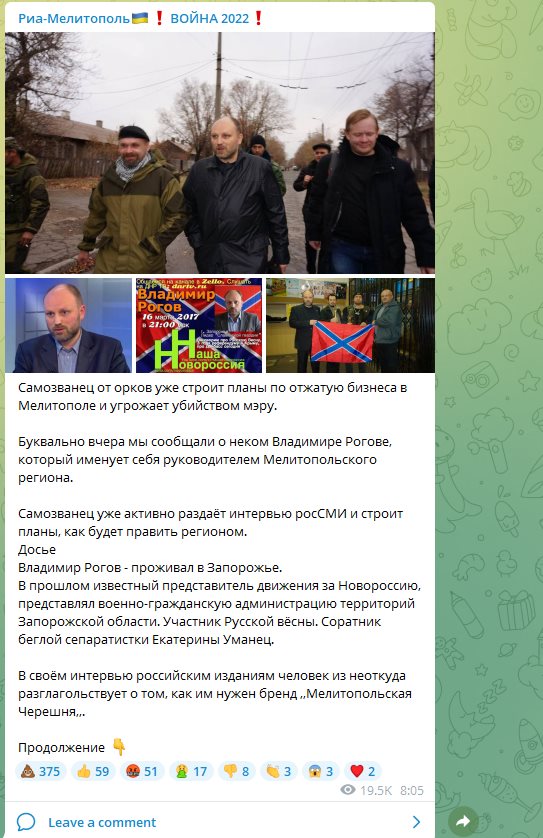
In the past, a well-known representative of the Novorossiya movement, he represented the military-civilian administration of the territories of Zaporizhzhya region. Participant of the Russian Spring. An associate of the fugitive separatist Kateryna Umanets.
In his interview with Russian media, the man out of nowhere talks about how they need the Melitopol Cherry brand.
⁃ Melitopol Cherry is the No. 1 brand. It was sold in tons in Russia. All fruits and vegetables went to the Russian market. Under Poroshenko and Zelenskyy, a ban on supplies to Russia was introduced. People suffered enormous losses. Rogov is preparing the oligarchs’ assets for nationalization. He is already threatening those mayors who are not ready to cooperate with him:
⁃Even here in Melitopol, during the distribution of humanitarian aid, they try to attack people who receive this humanitarian aid,’ the impostor complained, forgetting to mention the extras that are regularly brought to Melitopol from Crimea and the occupied regions to film Muppet shows with food distribution.
Billboards with the Chekist who led the operation to eliminate Trotsky appeared in Melitopol
In the Ukrainian city of Melitopol, occupied by the Russian military, several billboards have appeared with a photo of Pavel Sudoplatov and the caption “He knew what to do with the Banderites!” (punctuation in the original). This was reported by the community “Native Melitopol” and the local website Mltpl.city. According to the administrator of the Native Melitopol community, two billboards were placed in the city in early May: one on Bohdan Khmelnytsky Avenue and the other on Ivan Alekseev Street.
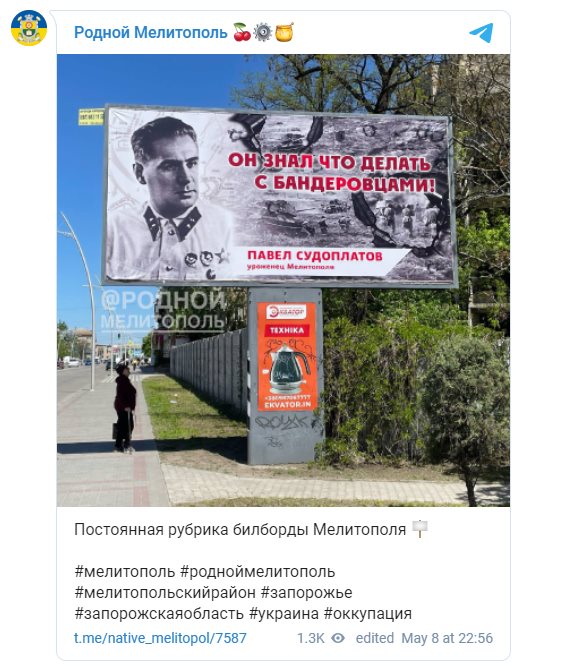
Volodymyr Rogov, who became the mayor of Melitopol after the arrival of the Russian military, said that the street named after Ukrainian philosopher and publicist Dmytro Dontsov in the city may change its name to Pavel Sudoplatov Street.
Zaporizhzhya as an indicator of the Russian threat or Who ordered the provocation against Komorowski
2013-07-23
The scandalous attack on the Polish president is not only a PR provocation that is beneficial to the Kremlin as a small but still a fly in the ointment of Ukraine’s European integration process, but also a possible symptom of Kyiv’s loss of control over the electorally important regions of the southeast of Ukraine and new opportunities that are opening up for those who rely on Vitali Klitschko.
History is full of mysteries and ridiculous coincidences. Some of them, the most significant ones, are remembered by everyone for a long time — while others, the small ones, disappear into the abyss of time and only occasionally make historians of the future shake their heads in wonder. The egg smeared on the jacket of Polish President Bronislaw Komorowski in Lutsk during his next visit to Ukraine has every chance of becoming such an inexplicable and absurd historical curiosity.
However, if we look into this story and compare the facts, we will realize that the front of a marginalized radical from Zaporizhzhia against the Polish president is part of a large and intricate political game. A game in which the local ambitions of regional princes are intertwined with the complex history of relations between the three Slavic peoples and the political stakes of Ukraine’s largest financial groups.
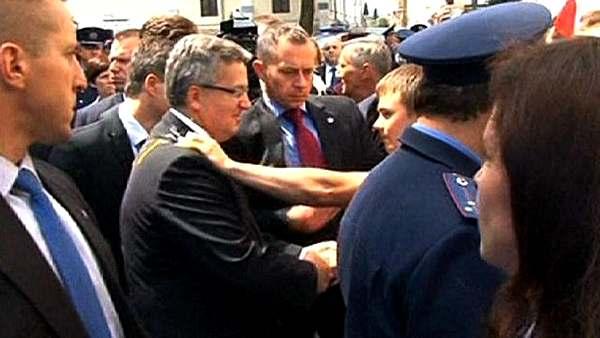
The details of this seemingly silly story have already been spread by Ukrainian news agencies last week. After Sunday Mass on July 14 at the Church of Saints Peter and Paul in Lutsk, Polish President Bronislaw Komorowski was approached by a young man who gently but forcefully pressed a raw chicken egg into the national leader’s jacket. The “egg terrorist”, who turned out to be a 21-year-old resident of Zaporizhzhia, Ivan Shemet, was immediately politely detained by Ukrainian law enforcement officers.
During interrogation by the SBU, Shemet, who was clearly not psychologically prepared for detention, revealed all his cards, admitting that he was an activist of Vladimir Rogov’s little-known Zaporizhzhia-based NGO Slavic Guard. According to Shemet, one of the organization’s board members, Konstantin Lysenko, promised him $500 for successfully fulfilling his role in the action.
At a press conference held on July 16 at the UNIAN news agency, the leader of the Slavic Guard, Vladimir Rogov, tried to convince journalists that Ivan Shemet’s action was a surprise to him. The head of the radical organization assured the Poles of his fraternal feelings towards them and did not express any negative feelings towards the Polish president. In addition, Rogow said that Shemet was not going to Western Ukraine with a plan to commit an act of terror, but only to visit the “places of Kovpak’s military glory” (Sidir Kovpak was a Ukrainian Soviet partisan, a hero of World War II).
Thus, the conference left many more questions than answers. If Shemet didn’t want to throw an egg at the Polish president, where did the story of the $500 come from? Lysenko’s story about how often he talked to Shemet during his trip to western Ukraine is obviously intended to justify the numerous organizational calls between the two “Slavic guardsmen” that were detected by the Ukrainian secret services on the day of the incident.
A game of divide and conquer
What is Vladimir Rogov’s “Slavic Guard”? This is a little-known and small pro-Russian youth organization in Zaporizhzhia, headed by a public figure with a local reputation as an adventurer, Vladimir Rogov. Volodymyr Rogov is actively trying to make money on Kremlin grants allocated to the “Ukrainian direction,” which has long been lacking in pro-Russian public activity. In Zaporizhzhia region, Rogov is known for regular PR on the topic of WWII commemoration, often as part of Russian-sponsored campaigns.
At times, Rogov’s use of Moscow grants has taken on extremely mysterious forms: in particular, he is behind the placement of billboards in the region with images of… Vladimir Putin. Who in the Kremlin could have been convinced of the success of this idea is a difficult question, but the fact that Rogov communicates with Russian agents of influence and tries to enter the circles of the Kremlin’s “PR specialists abroad” is beyond doubt. The same forces with which Rogov works have repeatedly acted as unofficial grantors in organizing provocations in Ukraine.
For example, in October 2007, members of the Eurasian Youth Union cut down and desecrated the national symbol of Ukraine, the Trident, on Hoverla, and smashed a granite memorial dedicated to the Constitution of Ukraine. In addition, the flag of the Eurasian Youth Union was hoisted over the mountain instead of the national flag of Ukraine, and Mount Hoverla was “renamed” to “Stalin’s Peak.” In April 2009, activists of Cossack and pro-Russian organizations in Crimea and Sevastopol erected a border post with the Russian flag at the entrance to Crimea, etc.
Immediately after the attack on the Polish president’s jacket, the Kremlin’s mouthpiece, Channel One, included a report on the incident among the day’s top stories. Could this have been a coincidence? Does Moscow benefit from the separation of Ukraine and Poland? Is the timing of the attack on the Polish president good in the context of the Sejm’s demarche, which recognized the events in Eastern Kresy in 1943-1944 as ethnic cleansing and stigmatized Ukrainian nationalists?
A logical answer to these questions suggests that the “velvet terror” against Komorowski was a PR campaign beneficial to certain circles in Moscow, which was presented by interested parties in Moscow as an action in line with a common game of cooling relations between Ukraine and Poland. However, the question of why it was a resident of Zaporizhzhia who worked for Russia’s interests is much more interesting than the possible intrigue of those seeking Moscow’s approval.
Summary
Vladimir Rogov is a Kremlin protege who has been involved in criminal cases for 30 years. He is currently an accomplice of the occupiers and actively misinforms Ukrainians by spreading Russian propaganda.