


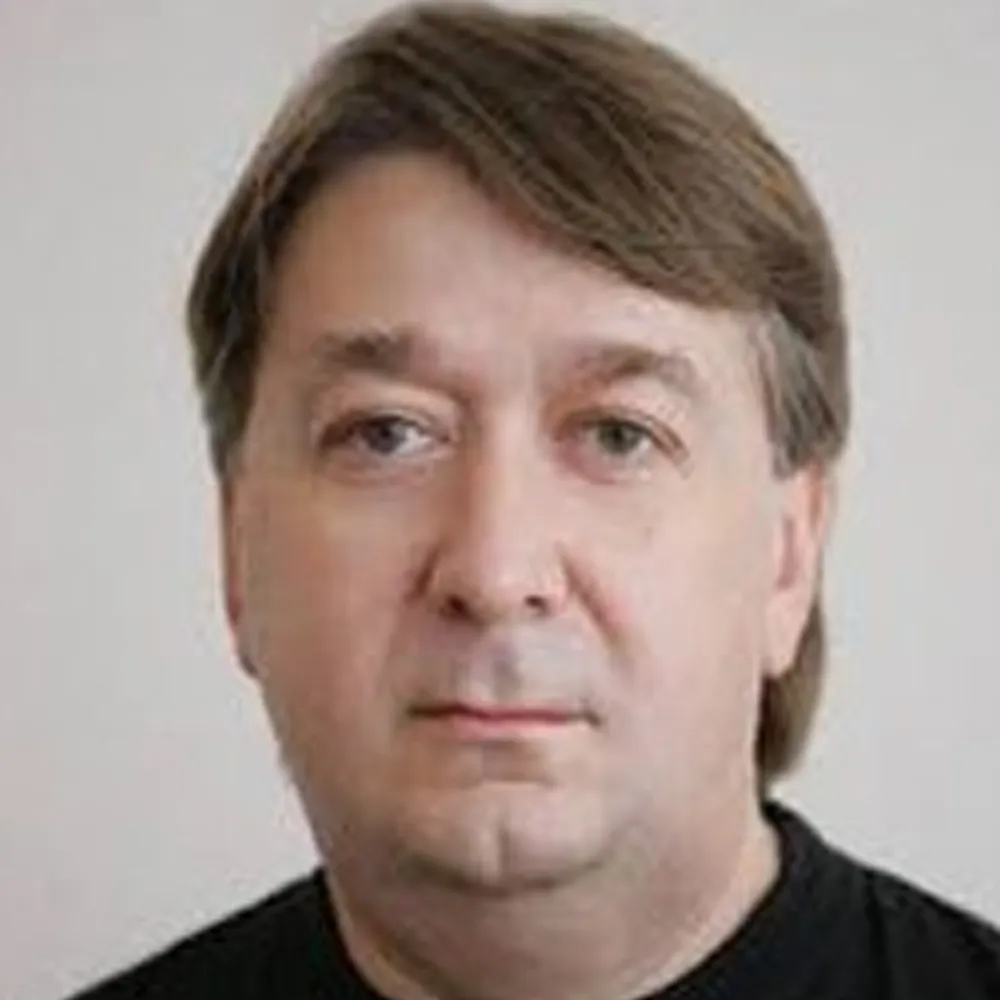
Abdullin Alexander Rafkatovich — “Gas King”
Official biography
Born on June 29, 1962 in Kyiv.
According to some reports, Oleksandr is a third-generation descendant of an academician, vice-rector of Kyiv University, who went to the front and died at the very beginning of the Great Patriotic War.
He began his career as a turner at the Tochelektropribor plant in Kyiv.
In 1985-1987, he worked as a correspondent for the News from Ukraine newspaper, then as a correspondent and commercial director of Rabocha Gazeta.
In 1989, he graduated from the Faculty of Journalism at Taras Shevchenko National University of Kyiv.
In 1992, Mr. Abdullin entered big business. He was the director of Intertrade, vice president of Respublika Corporation, and president of Intergas.
In the 1998 parliamentary elections, he was elected as a deputy in Boryspil constituency No. 97. At the same time, he ran for parliament on the list of the KhDPU (No. 10).
In 1999, Oleksandr Abdullin participated in the creation of the Democratic Union party. The structure was created under the patronage of the “managing director” of the parliament, Oleksandr Volkov.
In 2002, he was elected to the Verkhovna Rada of Ukraine in the Rivne constituency No. 156.
In the Parliament, he was a member of the following parliamentary groups and factions: “United Ukraine”, ‘European Choice’, SDPU (o).
Since March 2005, he has been a member of the Yulia Tymoshenko Bloc faction. Only Stepan Khmara publicly opposed Oleksandr Rafkatovych’s joining the faction (Ukrainska Pravda, May 30, 2006).
In the 2006 parliamentary elections, he was elected to the Verkhovna Rada on the Yulia Tymoshenko Bloc’s list (No. 74).
In the early parliamentary elections of 2007, he received a parliamentary mandate on the Yulia Tymoshenko Bloc list (No. 48). Deputy Head of the Yulia Tymoshenko Bloc faction.
On January 4, 2008, he was appointed a pro bono advisor to the Prime Minister of Ukraine.
Family.
His wife, Tetiana Rostyslavivna (born in 1963), is a designer of a construction company. According to one version, before her marriage to Abdullin, she was married to the son of a high-ranking party official.
The Abdullins raised their daughters, Yevgeniya (born in 1988) and Aleksandra (born in 1991).
Compromising material
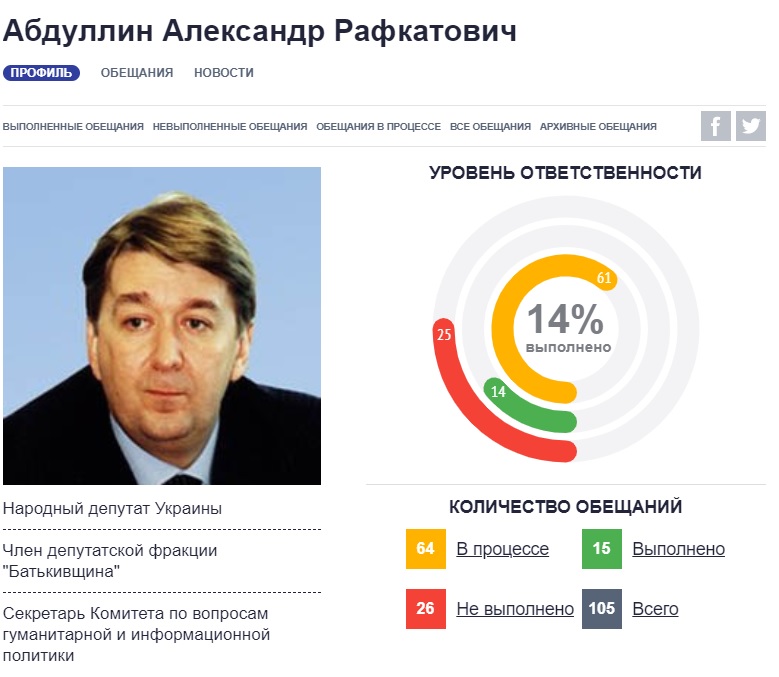
Much of the information that compromises Abdullin is related to his activities in the oil and gas sector in the late 90s: «The information compromising Alexander Abdullin relates to his ‘gas’ past. According to informed sources, even the US FBI was interested in him.» Stepan Khmara, a reputable politician, opposed his joining the Yulia Tymoshenko Bloc: «He is associated with the swindler Igor Bakai, who is one of the participants in Kuchma’s criminal activities,» Stepan Ilkovych was indignant. It is unlikely that the former dentist is referring to a sanatorium.»
“Tymoshenko’s purse”
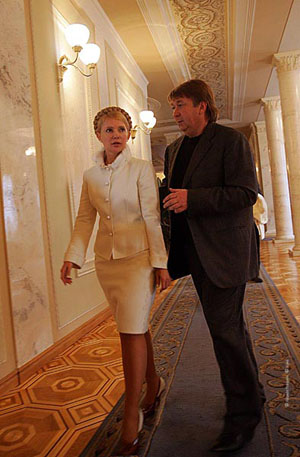
Why did Yulia Tymoshenko come in third place in the election, not second? She should ask this question to the person who financed and directed her election campaign, i.e. Oleksandr Abdullin. Five years ago, he took the seat next to her that was vacated after Oleksandr Turchynov fled, but he seems to be doing a very poor job. Abdullin failed to achieve Tymoshenko’s victory in 2014, let her down in the current presidential election, and may well fail Batkivshchyna in the upcoming parliamentary elections. The question involuntarily arises whether he is not a sent Cossack. And it is quite logical if we recall the facts of Abdullin’s distant past.
How did a journalist become a gas oligarch? Oleksandr Abdullin (an ethnic Tatar) was born in Kyiv, where he grew up in an old house on Lenin Street (now Bohdan Khmelnytsky Street). The apartment belonged to Abdullin’s grandfather, who was an academician and vice-rector of the Kyiv State University in the 1930s and died in 1941 as a militia member.
After graduating from high school, Abdullin went to the Tochelektropribor plant in Kyiv, where he became an apprentice turner, and then twice (in 1979 and 1980) tried to enter the geography department of the Moscow State University, but failed. In the end, the long arm of the Soviet military enlistment office caught up with him. According to him, he was taken to the army in a black Volga, and he served in an air defense unit in Vasylkiv (25 kilometers from Kyiv), being able to conduct discharges at home. After demobilization in 1983, Abdullin spent another year punching pears somewhere, and only in 1984 did he enter the Faculty of Journalism at the Moscow State University, where he was invited by a friend of the dean. He graduated from the university in 1989, so it’s not hard to calculate the year of his enrollment. These oddities gave rise to many rumors about what the young man, who was listed as a turner at the factory, could actually do. Moreover, after that, Abdullin’s luck began to run out: in 1985, the sophomore began to work part-time for several publications, including the mysterious English-language News from Ukraine (no information about this publication has been found), after graduating from university he made an instant career at Rabochaya Gazeta (from journalist to commercial director), and then in 1992 he jumped into big business.
Of course, Abdullin himself is not from a simple family, and neither is his wife Tatiana Rostislavovna (and before Abdullin she was allegedly the wife of the son of a member of the Communist Party of Ukraine Central Committee), but still, people told different things about him. For example, that before and after the army, Abdullin led a merry life of a Soviet major (as far as his parents’ income allowed), that once he got so seriously “in trouble” that he was forced to agree to cooperate with the Soviet authorities. That at first he allegedly helped them identify “anti-Soviet people” (hence his work for an unknown English-language newspaper), and then he was switched to working with Kyiv-based organized crime groups. There he met his “senior comrade” Oleksandr Volkov, who, according to SKELET-info, was assigned as an agent of the Urozisk to his neighbor Volodymyr Kysel (the late Kyiv “authority” nicknamed Grandfather).
All of this, of course, is just a rumor. However, in the early 90s, when the whole of Ukraine was plunged into crisis and hyperinflation, few people could afford to literally bathe in dollars. To do so, one needed to have access to export resources, as well as extensive connections in the government, law enforcement, and the criminal underworld. Abdullin then not only became rich, he became one of the first Ukrainian oligarchs to make a fortune in oil and gas. And interestingly, he is still hiding how he did it! So there is something to hide there…
In 1989, a young journalism graduate was tempted to take a series of photographs of the Chornobyl Nuclear Power Plant. With the help of his friends, he got permission and an escort with a dosimeter, and then, with the help of the same friends, he published these photos in the Western press-and, apparently, again with the help of his friends, he received an international award in convertible currency, with which he bought a separate apartment in Kyiv (rumor has it, from a repatriate). And as a bonus, journalist Abdullin received a certificate of “liquidator”, which entitles him to benefits and payments from the state.
In 1992, after leaving Rabochuyu Gazeta and his career as a journalist, Abdullin became the director of Intertrade, a company whose information has not been preserved (or has been carefully deleted). After working there for a few months, he moved to the position of vice president of the notorious Respublika corporation, created by Igor Sharov and Igor Bakai. This corporation entered the history of Ukraine in the wake of a major gas scandal, causing the state almost half a billion dollars in losses (and the dollar was many times stronger than today). And by the way, unlike the similar scandal with the UESU corporation, it did not have such a resonance and continuation: everyone quickly “forgot” that Bakai and his associates (including Abdullin) had defrauded the state of such a huge amount. This allowed them to carry out their next scams with ease. Again, the question is why?
Scams of the “Republic”
There are even more questions if we recall who the founders of the “Respublika” were. The first is Kirovohrad businessman Ihor Sharov, who, together with his brothers, opened the Inkompark company, which became one of the founders of Respublika. According to SKELET-info’s sources, Ihor Sharov moved to Kyiv because of his older brother, a police officer,’s connections with the former head of the Kirovohrad Regional Police Department, Yuriy Kravchenko (future Minister of the Interior). This happened just when Kravchenko became the head of the State Customs Committee of Ukraine in 1993, i.e., he opened the gates of customs to the Republic. Well, that’s more or less clear.
The second is Ihor Bakai, who until 1993 had been “interrupted” by trading in food and suddenly soared to the presidency of one of the largest gas companies, which also robbed the state of half a billion dollars with impunity. But the secret of his success is as surprising as the career rise of his assistant Abdullin. Perhaps he is indeed the nephew of the first president, Leonid Kravchuk, as various sources have repeatedly reported. But perhaps it was something else, and not Bakai’s family ties to Kyiv’s largest organized crime groups and their high-ranking patrons.
When Bakai ran in the 2002 elections in the majority constituency in Rivne, he was remembered for his political advertising in the company of the Klitschko brothers. This was, by the way, the first time the Klitschkos took part in big politics, even if only as a support team. Back in 1997, Bakai became the main sponsor of Vitali Klitschko, but he had become close to the sports star in the early 90s, when he was a protégé of the criminal authority Rybka (Viktor Rybalka). One might assume that Bakai “bought” Klitschko from Rybka, but this is not the case. Because in the early 90s, they were all one team: Bakai, Klitschko, and Rybka. At the same time, Oleksandr Abdullin joined their team, who was associated with another team — Oleksandr Volkov and Volodymyr Kysel (Grandfather). All of them (including Sharov) were united by a big business run through the Respublika corporation. Semen Mohylevych and his Kyiv-based “lookout” Oleksandr Pressman were also involved in this business. By the way, when Kisil was imprisoned in 1997, Bakai gave the money for his ransom (a million dollars), and Pressman brought it to the OCD.
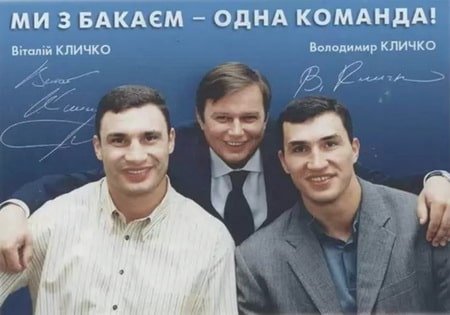
This business did not start with gas, but the history of the first major deals of the “Republic” is, as they say, buried in concrete. It seems that the corporation was involved in large-scale plundering of Ukraine and all sorts of scams involving both high-ranking officials and criminal “authorities”. Only one transaction has come to light (perhaps others will be revealed soon), and even then not in full. Namely, Bank Ukraina issued a loan of 30 billion rubles to a small bank called Alliance, which was used to purchase a batch of diamonds (possibly from state funds), and then these diamonds were sold through Respublika to Uzbekistan for 110 billion. Of course, no rubles were printed in Uzbekistan. We are talking about barter transactions, during which Respublika received some goods for the specified amount in exchange for these diamonds (or for a loan for which they were pledged), and then resold them at a profit. On the Ukrainian side, the deal was covered, by the way, by Vitaliy Masol, who soon afterward became prime minister again.
Obviously, there were many similar deals, and they allowed Bakay (and Abdullin, who accompanied him) to quickly pave the way to the palaces of Central Asian “emirs,” where he negotiated barter gas schemes. The situation was as follows: in early 1994, due to hyperinflation and a crisis of non-payment, the state-owned company Ukrgazprom owed Russia and Turkmenistan huge sums of money for gas, and they simply stopped selling it to it (and in February 1994, Russian Gazprom stopped gas transit through Ukraine for two days for the first time). This was the reason why those who could pay for gas in Ukraine, i.e., private companies, began to buy it. “Itera and Sodruzhestvo (since 1995, the UESU) purchased gas mainly from Russia, and the Industrial Union of Donbas from Uzbekistan, and fully served the interests of their owners.
“Respublika was supposed to become an intermediary between Ukrgazprom and Turkmenistan, and first of all, to pay off old debts — this is what Leonid Kravchuk, who was preparing for early elections, blessed it with.
The authorized capital of Respublika was about 4 thousand dollars, and Ukraine’s gas debt to Turkmenistan was 672 million dollars. The Republic had virtually no money of its own, but using an “unlimited loan” from the Cabinet and the President, in a few months of 1994, the Republic, under the leadership of Bakay, Sharov and Abdullin, somehow settled the old debts of Ukrgazprom. Moreover, the Turkmen president Niyazov became a great friend of Bakai’s, and he probably received good kickbacks from this. However, pleasing Turkmenbashi cost Ukrainian enterprises dearly, whose products shipped to Turkmenistan remained unpaid, and loans taken from Ukrainian banks were not repaid. The same happened with Turkmen gas supplied under new contracts in 1994: The “Republic” almost paid Turkmenistan for it, but again did not return anything to Ukrainian enterprises and banks or to the Ukrainian budget.
Where did the money go? According to SKELET-info’s sources, a significant part of it went to finance Kravchuk’s election campaign (presidential elections), plus the election funds of several officials and businessmen who ran in majority districts (parliamentary elections). Apparently, this was the main reason why, after the elections, Respublika quickly shut down its activities. But here’s a new mystery: 2.2 billion cubic meters of gas belonging to Respublika remained untouched in Ukrgazprom’s storage facilities for two more years (!), and no one dared to confiscate them to pay off the corporation’s debts to the budget and state-owned enterprises, which reached half a billion dollars! Moreover, soon after, the documents of Respublika were burned in a mysterious fire at its headquarters.
Fraudsters from “Intergaz”
In February 1995, Intergaz CJSC (USREOU 22298336) was founded in Simferopol. For a long time now, it has been an unremarkable company, engaged in no one knows what and registered to some straw men. However, it was from this company that Bakai and Abdullin’s new large-scale project began. In a few months, they registered a number of subsidiaries of the same name in Ukraine, the main holding in Kyiv (Intergas JSC), and Intergas Inc. in Pennsylvania (USA), with Ihor Sharov as its director. The head office of Intergas was headed by Oleksandr Abdullin, who remained in this position until the spring of 1998, when he received a mandate as a member of parliament, and Ihor Sharov (as chairman of the board).
Interestingly, the first vice president of Intergaz, i.e. Abdullin’s deputy, was then an Ivano-Frankivsk businessman, Oleksiy Ivchenko, the future scandalous head of Naftogaz and the future owner of Eurogazbank, which collapsed, shoehorning depositors and creditors for 2.18 billion hryvnias. It was with his position at Intergaz, in the team of Bakai, Abdullin, Pressman, and Kisel, that his rapid gas career began. But how he got there remains a mystery. Ivchenko is a very dark horse, it is only known that he was a man from a group that controlled the oil and gas business in Galicia and decided to participate in Bakai’s big idea.
Together with Bakai, Abdullin repeatedly traveled to the United States, where they were engaged in the purchase of expensive real estate for money withdrawn from the Ukrainian Intergas to its Pennsylvania branch, Intergas Inc. Again, it was known that Bakai and Sharov had bought a “ranch” there, but information about Abdullin was again carefully deleted. As well as all the details about Intergaz’s activities, although it was not easy to hide them: the corporation was the largest gas importer. In 1996 alone, Intergas purchased 10 billion cubic meters of natural gas from Gazprom at a price of $80, which was much more expensive than Turkmen gas ($55), but for some reason Intergas switched from Turkmenistan to Russia. Perhaps the name of this reason was Pressman — he was a “lookout” for Mogilevich, who, for his part, was interested in selling Russian gas (not “Gazprom’s” gas, but through Gazprom).
However, in 1996, Pavlo Lazarenko, who had been patronizing the UESU corporation (Yulia Tymoshenko), became prime minister. Things did not go as well for Intergaz as they could have, but the Bakai-Sharov-Abdullin team managed to grease Leonid Kuchma’s palm. Back in 1996, Igor Sharov, who defected from the Communist Party (the gas oligarch was elected to the Rada as a communist) to the pro-presidential Constitutional Center, was appointed Kuchma’s representative in parliament.
In 1997, Ihor Bakai was appointed Deputy Minister of Oil and Gas Industry of Ukraine. A few months later, Bakai abandoned his scams with private companies and created the state corporation Naftogaz of Ukraine, which included the structures of Ukrgazprom and Ukrgaz, which collapsed. According to Bakai’s plan, Naftogaz became a gas monopoly, so the activities of all other gas companies were curtailed.
How did Kravchuk’s “nephew” manage to gain Kuchma’s trust so quickly? Perhaps Oleksandr Volkov, who financed Kuchma in the 1994 elections and has been a member of Leonid Danilovich’s inner circle ever since, helped him do so. And the common link between Bakai and Volkov was the “authority” Kisil.
By that time, Oleksandr Abdullin had already acquired a mandate himself, having been elected to the Verkhovna Rada in the spring of 1998 in constituency 97 (Kyiv) and joined the ranks of eternal MPs-he has been in the parliament for 21 years, as they say. And this was very useful to him in 1998, when the Prosecutor General’s Office opened a criminal case against Abdullin and three of his partners: Oleg Rafalsky, Valery Akopyan, and Oleg Zeldin.
Hakobyan was the chief accountant of Respublika and Intergaz, i.e. a direct participant in all their dirty schemes. Rafalsky was called Sharov’s man — he was also from the Kirovohrad group, but in the ‘noughties he joined the Donetsk group and served Yanukovych faithfully for a long time, making a career as a deputy of his administration (2010-2014), after which he moved to serve Turchynov and then Poroshenko. There is no information about Zeldin, and it is possible that he was closely associated with Abdullin, who was also carefully clearing his past.
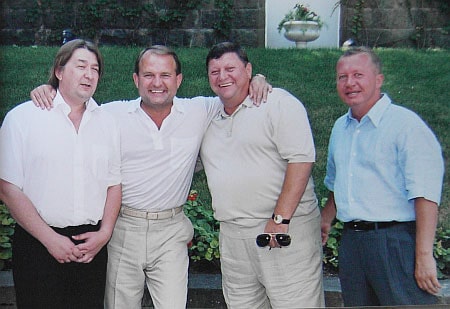
The four were charged with large-scale scams involving barter operations for the purchase of gas, theft of money from state-owned enterprises that supplied products for barter payments for gas, non-payment of huge sums to the budget, as well as money laundering through Ukrgasbank and transfers of large sums abroad (in particular to the United States). The case was initiated, and investigators seized bundles of documents from Ukrgasbank. However, then, on orders from above, the investigation was curtailed, the documents were returned to the bank, and the case was forgotten — after which a fire occurred again, and all the evidence allegedly burned. As you can see, Abdullin was burning evidence in the literal sense of the word!
From Kuchma to Tymoshenko or “Tymoshenko’s Wallet”
The first Maidan scattered old friends and associates. Ihor Sharov joined the Lytvyn Bloc and then moved to the Party of Regions. Ihor Bakai, who in 2003-2004 headed the State Administration of Affairs (the infamous “DUSya”), fled to Russia immediately after the Maidan, where he became a citizen. Oleksiy Ivchenko was the best fit, because as the head of the KUN (Congress of Ukrainian Nationalists), he became part of Yushchenko’s entourage and was given Naftogaz to feed. Alexander Abdullin, on the other hand, managed to change his shoes in a flash: he remained a social democrat and stuck with Medvedchuk during the Maidan, and on March 4, 2005, he appeared next to Yulia Tymoshenko as her new ally and sponsor.
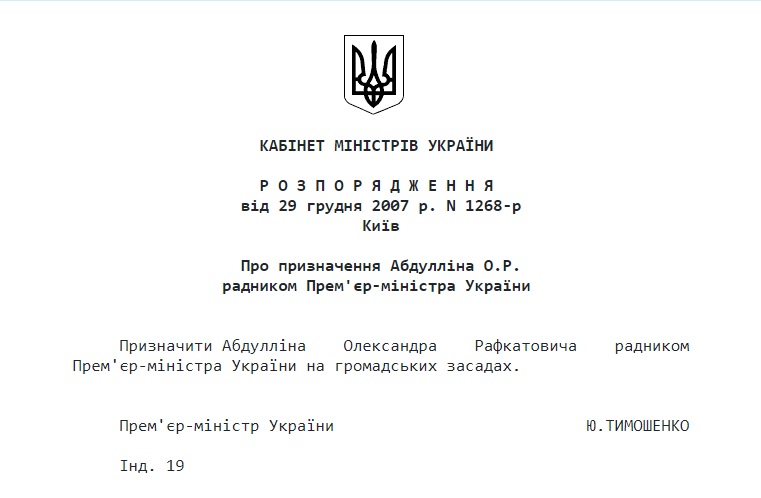
This led to a scandal: a well-known Ukrainian dissident and right-wing politician, Stepan Khmara, who joined the Yulia Tymoshenko Bloc in 2001, strongly opposed Abdullin’s membership in Batkivshchyna. Khmara could not forgive Abdullin for the 1998 elections, where they faced off in the 97th constituency:
Then the “gas king”, using bribery and all sorts of dirty methods, simply crushed his opponent, who hoped to win “the old-fashioned way” by honest campaigning. From then on, Khmara saw Abdullin as a “Kuchmaist”, Medvedchuk’s accomplice and a corrupt official, and he was furious when Abdullin was forced to join Tymoshenko’s inner circle. Khmara was principled, so Tymoshenko had to choose. And although Khmara was a political authority, “She” chose Abdullin — or rather, his money, very big money. Indeed, since then, Abdullin, apart from regularly buying a place on the Batkivshchyna list, has not wanted any other money to finance the party, which is why he has been nicknamed “Tymoshenko’s wallet.” And since 2006, he has been regularly elected as a deputy on the party list for four times, rising from 74th to 49th, then to 28th, and now to 17th place.
By the way, in 2014, Abdullin was one of the few old associates of Tymoshenko who did not run away from her to the People’s Front. According to sources, it was Abdullin’s money that helped Tymoshenko, who had just been released from prison, to regain her senses and get back on her feet, literally saving the party itself. So now he is not only a “wallet” but also a very trusted person of Yulia Vladimirovna. The media reported that Abdullin even bought out Ecotechprom LLC from Oleksandr Turchynov, which has been leasing the building where the main office of Batkivshchyna is located (13 Turivska Street) since 2005.
Abdullin traditionally heads the party’s “information department” on the grounds that he was once a journalist, albeit for a short time. In addition, as the party’s “wallet,” he also pays for the work of the Batkivshchyna press service and for paid-for media materials. This allows him to shape opinions in two directions: not only to convey Tymoshenko’s appearance and position to voters (which he himself largely shapes), but also to provide the party leader with an overview of public sentiment. In fact, Abdullin is also Tymoshenko’s chief political strategist. All this, you know, opens up many different opportunities for him. But how will Abdullin now explain Tymoshenko’s election defeat, in which he is also directly to blame? In 2014, it was still possible to write it off as force majeure, as the betrayal of fugitive associates, but now? But Abdullin knows how to pretend to be a loyal associate, even if he is blatantly wrong.
“Artur, you’re a jerk, you’re just a jerk!” — with these words Abdullin tried to stop the recent speech of Artur Gerasimov (head of the BPP faction), who voiced the recorded negotiations between Tymoshenko and Kolomoisky from the rostrum of the Verkhovna Rada. Well, he tried — but he failed, and that’s the whole point of Abdullin. He was surely aware of Gerasimov’s intentions and could have “settled” this issue with him on the sidelines.
Where did the money come from?
In 2014, Abdullin declared 173 thousand 40 hryvnias of income, 1 million 127 thousand 453 hryvnias in bank accounts and 23 million 570 thousand 500 hryvnias of contributions to the authorized (compound) capital of a company, enterprise or organization. Other members of his family earned UAH 192 thousand in dividends and interest, and UAH 2 million 36 thousand 417 in bank accounts.
The MP also declared an apartment of 66.5 square meters and a Porsche Cayenne car for himself, and an apartment of 139.5 square meters, Mercedes-Benz SL and Audi A6 cars for his family members.
In the declaration for 2015, Abdullin’s real estate remained the same, and the MP also owned a Porsche Cayenne and a Hyundai Accent. His wife Tatyana Smolenskaya owns Mercedes-Benz SL and Audi A6. In addition, Abdullin declared four pairs of men’s watches (Patek Philippe, Ulysse Nardin, Frank Muller and Vacheron Constantin), and two pairs of women’s watches (Girard Perregaux, Vacheron Constantin) for his wife. He listed the same watches in his 2016 and 2017 declarations. Abdullin also owns corporate rights to Ecotechprom LLC and MC-Finance LLC is registered in his name. These companies also appear in subsequent declarations.
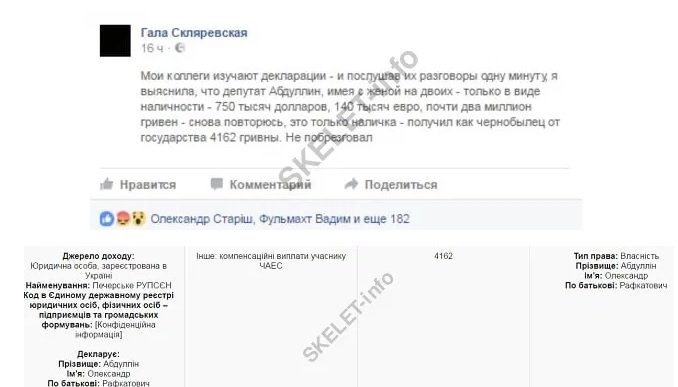
In 2015, he earned UAH 77,561, received UAH 80,559 for the performance of his parliamentary duties and UAH 4,162 in compensation payments to a participant of the Chernobyl nuclear power plant. Abdullin also declared 425 thousand hryvnias, 187.5 thousand dollars and 35 thousand euros in cash, and 92 thousand 998 hryvnias in bank accounts. His wife earned UAH 381,804 in dividends and interest. She had 425 thousand hryvnias, 187.5 thousand dollars and 35 thousand euros in cash, and 2 million 71 thousand 901 hryvnias in bank accounts.
In the 2016 declaration, the MP’s real estate was listed as the same, but there were only two cars — a Porsche Cayenne (owned by Abdullin) and a Mercedes-Benz GLA220 owned by his wife. Abdullin’s income included UAH 158,206 in salary, UAH 169,871 for the performance of his parliamentary duties, UAH 2,680 in compensation to a Chernobyl NPP participant, UAH 1,530 in exchange rate differences, and UAH 150,000 in income from the alienation of movable property. The MP declared 100 thousand hryvnias, 187.5 thousand dollars and 35 thousand euros in cash, and 16 thousand 63 hryvnias and 2 thousand 993 dollars in accounts.
In the last year’s declaration, the MP’s real estate changed significantly: Abdullin’s other property rights include a residential building (519.4 square meters) and two land plots (3 thousand square meters and 200 square meters). Cars, valuable property and companies in the declaration remained the same.
In 2017, Abdullin declared UAH 259,322 in salary, UAH 252,825 in expenses for the performance of his duties as a deputy, and Smolenskaya had UAH 340,214 in interest income. The spouses’ cash balances remained the same: Abdullin has UAH 15,497 and USD 2,960 in his bank accounts, and his wife has UAH 1,963,875 and USD 3,870. The declaration also lists his wife’s income as UAH 381,805 in interest, UAH 500,000 and UAH 149,000 in income from the alienation of movable property. Tetyana Smolenskaya has the same amount of cash as her husband, and bank accounts of 1 million 909 thousand 685 hryvnias and 6 thousand 490 dollars.
“I worked in +40 in Turkmenistan and in -40 in Russia,” Oleksandr Abdullin replied with irritation to journalists’ questions about the origin of his capital when the Prosecutor General’s Office began checking his parliamentary declaration in early 2017. Unfortunately, the journalists were not well aware of the MP’s past, and therefore did not specify what exactly Bakai’s deputy “worked” there and where. But now it’s easy to guess: he was hiding from the Turkmen heat in the cool palaces of Ashgabat, and waiting out the Russian frosts in Moscow hotels.
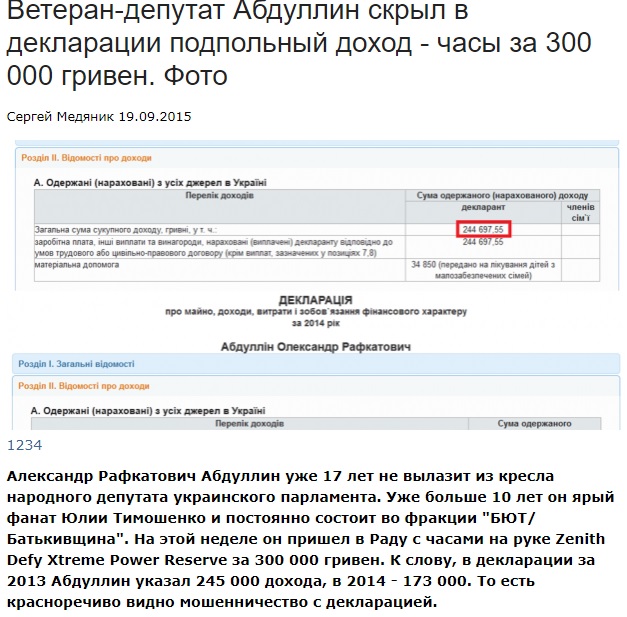
What was he being investigated by the Prosecutor General’s Office for? No specific claims were published, but a number of his declared amounts did raise questions. Firstly, Abdullin claims that since 1998, as an MP, he has not been involved in any business. Secondly, for the period from 1998 to 2015, he declared only UAH 2.34 million in income — only his deputy salary plus social benefits and material assistance.
Well, in both cases, Abdullin lied, although he got away with it, and the Prosecutor General’s Office left him alone. Firstly, the media have long reported that Abdullin is a co-owner of Slavic Heritage CJSC (his partners in it were Bakay and Akopyan) and Hermes Invest Holding CJSC, the Rezer Fund and Osnova CJSC. This is only what journalists managed to find in Ukraine, but Abdullin has “stashes” abroad, dating back to the days of gas schemes.
In addition, his declaration reflects MC Finance LLC and the aforementioned Ecotechprom LLC, but for some reason the profit received from them is not indicated. Secondly, for some reason, Abdullin did not reflect in his income the income received from the sale of a villa in Le Cannes, which is two million dollars or 10 million hryvnias at the then exchange rate! Not to mention the fact that, according to sources, Abdullin acquired several properties abroad in the 90s, which he rented out profitably.
But Abdullin still had to finance Batkivshchyna for so many years! For what kind of money? However, his sponsorship is not reflected in the declarations, although it is known that MC Finance LLC, which he owns, only officially transfers up to 25 thousand hryvnias a year to the Yulia Tymoshenko Bloc’s cash register.
And here’s another “small scandal”: in addition to receiving regular financial aid as an MP (about 40 thousand per year), Oleksandr Abdullin did not disdain to get himself another 4162 hryvnias of social compensation due to the “Chernobyl victims”. This sincerely outraged the journalists who learned about it.
But in addition to having hundreds of thousands of declared hryvnias and dollars in his accounts, as well as companies, cars and spacious real estate in Kyiv and the region, Oleksandr Abdullin also owns a collection of expensive watches.

For example, in 2015, he was photographed in the Rada with a Zenith Defy Xtreme watch on his wrist: at that time, its market value reached 300 thousand hryvnias, and now it costs even more. But he did not indicate the presence of this watch in his declaration.
From the investigation of journalists
In his 2011 declaration, Abdullin indicated that his bank account
bank account and another 16 million in his wife’s account. В
In 2013, their total capital decreased to 25.8 million hryvnias, and in
In 2014, they allegedly spent 23.6 million on the purchase of
“Ecotechprom LLC, after which, in the following years, 2
million hryvnias and about 450 thousand dollars in cash (where did they get it from?).
The apartment in Kyiv with an area of
136 square meters, bought in 2012 and valued at… 259,249 hryvnias
(less than 33 thousand dollars at the exchange rate of that year)
Business.
According to proUA, Abdullin is involved in the creation of the following commercial structures:
CJSC “Slavic Heritage”;
CJSC Hermes Invest Holding;
CJSC “Osnova”;
LLC “Fund ‘Reserve’.
Among Abdullin’s business partners is Konstantin Zhevago, with whom he is associated through Hermes Invest Holding CJSC.
Oleksandr Rafkatovych is also believed to be involved in the Proletarska Pravda Fishery CJSC and Tri O LLC.
Although Abdullin himself reacts quite painfully when he is called a businessman. “I have never called myself a businessman,“ he says (”Ukrainska Pravda”, May 30, 2006).
“Socialite” Oksana Moroz
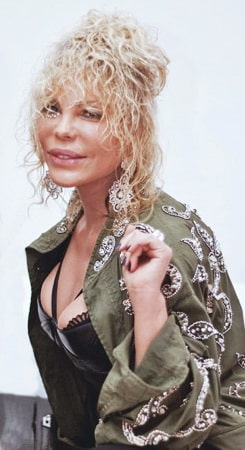
In 2002, Abdullin was featured in a scandalous story that unwittingly revealed the size of this “modest” MP’s real wealth and reminded us of his passion for foreign real estate. And what happened was this: Kyiv’s “socialite” Oksana Moroz (a former currency prostitute and mistress of gangster “authorities” who became Oksana Hunt and opened a super-fashionable boutique called Sanahant on Hrushevskoho Street in Kyiv, where many officials and MPs dress) decided to “suck up” to her next husband, American businessman Alex Hunt. She begged him for a villa in France, and not just anywhere, but in Cannes, a famous resort where famous film festivals are also held. However, it was not possible to buy a villa on the beach, and Hunt gave his wife a mansion in Le Cannes, a small town two kilometers north of Cannes. He did not realize that Oksana Moroz had already set her plan in motion, and in a few months she would throw Hunt out the door with nothing. And this whole operation was carried out by Oksana Moroz with the help of her longtime patron Vladimir Bedrikovsky.
So, according to the publication, this villa in Le Cannes was sold to Hunt by none other than Alexander Abdullin! He asked for two million dollars for it, and immediately received half of the amount from Hunt (850 thousand in cash), and the rest from Oksana Moroz, who stole money from her husband’s accounts. And judging by the fact that Abdullin was not too upset about the sale of the villa in such a beautiful place (sea, sun, film festival), he had something else in store!
Illegal land in Pushcha-Vodytsia
In 2004, more than 500 hectares of forest were allocated for long-term lease in Pushcha-Vodytsia by a decision of the Kyiv City Council. As a result, 170 “summer residents” appeared, one of whom was Abdullin, who received a plot of 2.72 hectares. In May 2005, the Shevchenkivskyi District Court of Kyiv, following a lawsuit filed by Vitaliy Kononov, leader of the Green Party, declared the Kyiv City Council’s decision to transfer the land in Pushcha-Vodytsia to private ownership illegal. In 2005, Stepan Khmara publicly opposed Oleksandr Abdullin’s joining the faction. However, Abdullin himself interprets Khmara’s dislike of him as follows: “We have a long history with Stepan Ilkovych — he lost the election in the majority district in Boryspil in 1998. It was a shock for him! After that, our relationship did not work out.”
Connections
Igor Bakai, Ukrainian oligarch, Russian citizen
Yulia Tymoshenko, former Prime Minister of Ukraine
Kostyantyn Zhevago, Member of Parliament of Ukraine
Oleksandr Volkov, Ukrainian oligarch
Oleg Rafalsky, Deputy Head of the Presidential Administration of Ukraine
Valeriy Akopyan, Director of the Executive Directorate of the Social Insurance Fund for Industrial Accidents and Occupational Diseases of Ukraine.
Ihor Didenko, former First Deputy Chairman of the Board of Naftogaz of Ukraine.
Oleksiy Kucherenko, former Minister of Housing and Communal Services of Ukraine.
Oleg Zeldin, Managing Partner of Apex Berg Contact Center Consulting.
Regalia
Honored Journalist of Ukraine.
He was awarded the Order of Merit II and III degrees, Holy Equal-to-the-Apostles Prince Vladimir I and II degrees, Certificate of Honor from Pope John Paul II, Medal of Merit I degree (Afghanistan Veterans Union).
Member of the Verkhovna Rada Committee on Freedom of Speech and Information.
Member of the groups on interparliamentary relations with Russia, Switzerland, and Austria.
Resume
Oleksandr Rafkatovych is a fruit of the field, his insatiable appetite for real estate and money is exorbitant. His ties to Bakai, Tymoshenko and other aforementioned individuals gave him many opportunities for privatization (in many cases illegal) of land and real estate. And the false information in the declaration shows us the “conscientiousness” of this person.