


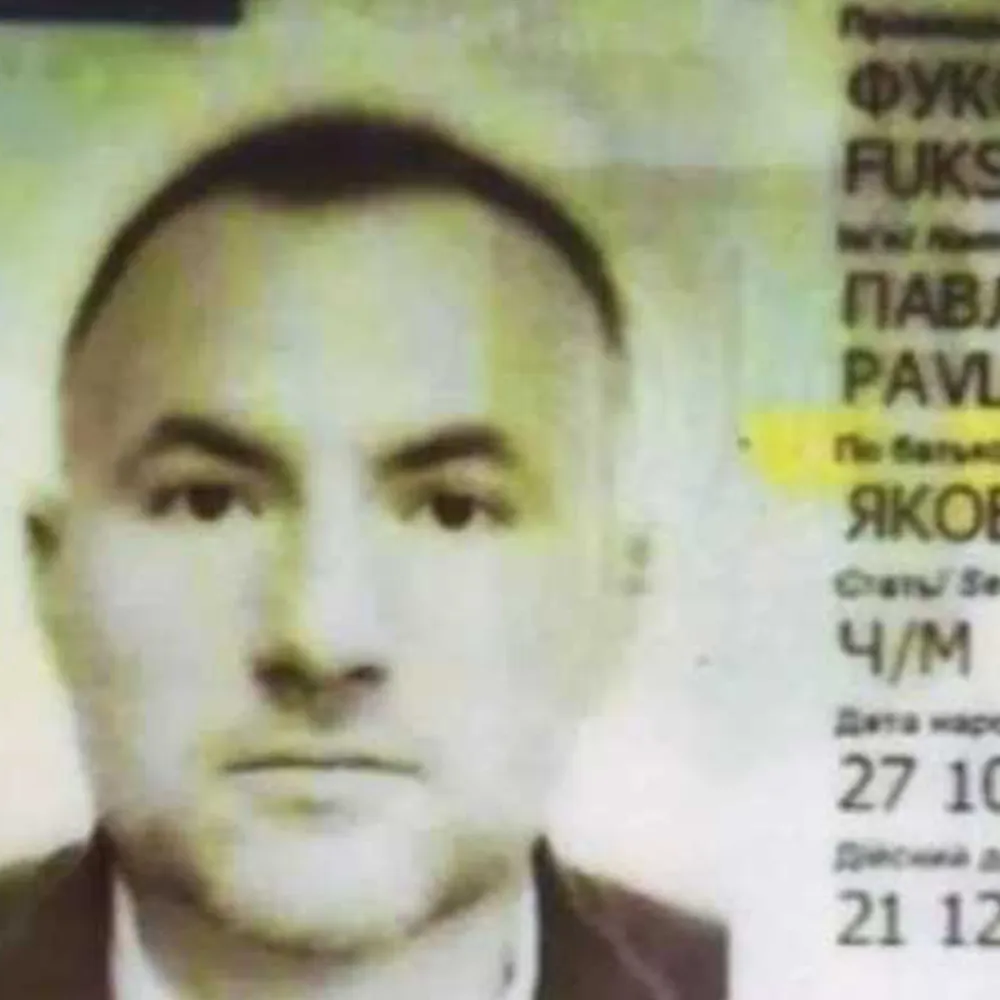
Pavlo Yakovlevich Fuks
Official biography
Pavel Yakovlevich Fuks is a Ukrainian and Russian businessman, philanthropist, and founder of the Mos City Group development company. He was born on October 27, 1971 in Kharkiv.
In 1994, he graduated from Kharkiv National University of Civil Engineering and Architecture (specialty “Economic and Social Planning”, Faculty of Finance and Credit). In 1992-1994, he worked as an advisor to the General Director of the joint Soviet-American enterprise Intrada Trading House.
From 1997 to 2003, he continued his studies at the correspondence department of the Plekhanov Russian Academy of Economics. He graduated from the Plekhanov Russian Academy of Economics with a degree in World Economy.
Career.
He worked in finance and wholesale trade. From 1995 to 1999, he was an advisor to the Chairman of the Board of Prominvestbank.
- In 1999-2000, he was Vice President of ZAO Vnesheconomicheskaya Korporatsiya.
- In 2002, he entered the development business. Among his first projects was the Kaluga shopping center. In the same year, together with the head of Ingeocom, Mykhailo Rudyak, he founded Ingeocom-Invest and became chairman of the board of directors (until 2004). In 2004-2006, he was CEO of his own company, CJSC Tekhinvest.
- In 2006, he founded Mos City Group, which by the beginning of 2008 had assembled a portfolio of about 7 million square meters, including several skyscrapers in Moscow City, namely Imperial Tower (280 thousand square meters) and Eurasia Tower (211 thousand square meters), and became one of the largest development companies. In the fall of 2007, MCG acquired the Aerostar hotel on Leningradsky Prospekt in Moscow. MosCityGroup was a minority owner of OJSC Olimpiyskiy Sports Complex and was applying to buy the city of Moscow’s share in the sports complex. Since 2009, Fuchs has been a member of the board of directors of SC Olimpiyskiy. But in May 2014, Pavel Fuks sold his 27.5% stake in the Olimpiyskiy sports complex to Dmitry Shumkov.
- In 2008, he joined the Board of the Union of Industrialists and Entrepreneurs of Russia. In June 2008, he negotiated with the current US President Donald Trump on the construction of Trump Tower in Moscow, but the businessmen did not reach a mutually beneficial agreement.
- Since 2010, Pavel Fuchs has been the majority shareholder of Sovcombank, owning a 21.83% stake. In March 2015, he sold his stake, which was valued at $80 million. At the time of its purchase by Pavel Fuks, Sovcombank was ranked 98th in the Russian bank ranking, and at the time of the sale, the bank moved to 19th place in the RAEX national ranking of Russian banks and was in the top 5 in terms of return on equity.
Fuchs was called one of the most likely buyers of Prominvestbank, controlled by Russia’s Vnesheconombank. However, the businessman failed to get approval from the NBU.
Net worth
Pavlo Fuks has been repeatedly included in the Finance magazine’s billionaires’ list. In 2011, he was ranked 150th in the ranking of Russian billionaires, with a 0* (starting a business from scratch) label and a net worth of $0.74 billion. The businessman’s interests include real estate development, banking, and the oil and gas industry. In 2017, according to the Focus magazine rating, Pavlo Fuks was ranked 24th in the 100 richest people in Ukraine with a net worth of $270 million.
According to media reports, he is one of the contenders for the purchase of VEB’s Ukrainian subsidiary, Prominvestbank. The Antimonopoly Committee received a request from Pavel Fuks, founder of the MosCityGroup development company, to buy more than 25% of the bank.
Family.
His wife, Tatyana Fuks, is the founder and owner of the TAJ jewelry brand. She has four children.

In July 2016, Paul’s daughter Anastasia Fuchs married a British millionaire with Lebanese roots, Masoud Abdelhafid.

Compromising
Speculator and intermediary
Pavlo Fuks, a graduate of the Kharkiv National University of Civil Engineering and Architecture, made his first money in the early 1990s by speculating. More than a decade ago, in an interview with a Forbes correspondent, he recalled that one of his first commercial operations was selling Winston cigarettes.
Together with his partners, Fuchs bought a shipment of cigarettes for $200,000, and by the time the delivery reached Kharkiv, the price had almost tripled due to inflation. In 1992, the 20-year-old Fuchs got a job as an advisor to the CEO of the Intrada Trading House. This company supplied office equipment and computers to Ukraine. The position was formal, Fuchs explained in a 2019 interview with the Ukrainian publication Ekonomichna Pravda. He could not recall the details of those years and the names of his partners, citing the fact that he was actively involved in boxing at the time.
In 1994, Fuchs moved to Moscow and founded his own company, Soyuz Invest, which, as he mentioned in an interview with Ekonomichna Pravda, sold alcohol and vodka in addition to equipment. Over time, the scale of the business grew, and Fuchs began to participate in chains of mutual settlements between former Soviet industrial enterprises. For example, he took part in barter deals between Gazprom and Beltransgaz.
Fuchs told a Forbes correspondent that the Belarusian company often paid Gazprom with products, such as fabrics or furniture. If Gazprom refused to accept such payment, the “illiquid” had to be resold, and the proceeds were used to buy something that the gas monopoly was interested in.
Another counterparty of Fuchs was the Russian nuclear fuel producer TVEL, whose enterprises could not always pay their suppliers. Fuchs supplied them with petroleum products or coal on credit. One day, TVEL’s companies were unable to pay Fuchs on time, and he came to the holding’s headquarters to negotiate. They referred to a large debt that TVEL was not repaid by Energoatom, the operator of Ukrainian nuclear power plants. “I came to the head office and they said: “The Ukrainians don’t pay us,” Fuchs recalled: “These are my countrymen”. As a result, I bought $60 or $62 million of Energoatom’s debts to TVEL from them. After that, Fuchs moved to Kyiv for a few months and managed to get Energoatom’s biggest debtors to pay him off. To do this, he had to meet with Yulia Tymoshenko, who in December 1999 became Vice Prime Minister of Ukraine and began to oversee the fuel and energy sector.
Fuchs recalled that he demanded that Tymoshenko transfer to him the debts of Ukraine’s largest industrial enterprises and even resorted to blackmail. It was at this time that Zaporizhzhia NPP was supposed to exchange spent nuclear fuel for fresh fuel — for this purpose, TVEL sent a special carriage with fuel elements to Ukraine. Fuchs allegedly managed to get the railroad car stopped at the border. “As a result, I was able to collect money from industrial electricity consumers,” Fuchs claimed. At the same time, he met businessman Ihor Kolomoisky, whose companies demanded a 10% discount from Fuks. Fuchs gave in, and the two businessmen became friends.
Developer
According to Fuchs, the founder of Ingeocom, Mykhailo Rudyak, opened the way to development for him. The businessmen met in 1998 and for a long time “just talked”. In 2003, Fuchs suggested that Rudyak join forces. At that time, Fuchs already had a modest experience in development — he had built two cottage villages in Rublevka. The partners created the company Ingeocom-Invest on a parity basis, to which Rudyak transferred two sites — business center construction projects on Paveletska and Bolotna squares. Another partner of Fuchs was businessman Alexander Ter-Avanesov, who became a senator from the Kostroma region in 2006. Together with Ter-Avanessov, Fuks invested in the construction of the Kaluga shopping center, and they were also co-owners of the Tekhinvest company, which in 2002 became the developer of one of the plots on the territory of the future Moscow City.
According to Fuchs, he was persuaded to take on this project by Moscow Vice Mayor Joseph Ordzhonikidze. He was allegedly looking for an investor for the last unoccupied plot in the future business center (N12) and initially offered it to Rudyak, and after the Ingeocom founder refused, he met with Fuchs several times. In an interview with Forbes, Fuchs said that he had long doubted whether to take on the project — almost no one believed in the idea of Moscow City at the time. But he decided to take a chance. For the option to develop plot N12, Techinvest paid the Moscow government about $7 million. “We were among the pioneers of Moscow City, along with companies such as Mirax Group, Enka, and Capital Group. We adopted foreign experience in New York and Canada,” Fuchs later boasted.
Soon, another partner appeared in the project. In 2003, the former Minister of Energy, Industry and Trade of Kazakhstan, Mukhtar Ablyazov, moved to Moscow. In his homeland, Ablyazov owned the largest Kazakh bank, TuranAlem (renamed BTA Bank in 2008), and in Russia he began building the Eurasia development group. According to Kommersant, Ablyazov met Fuks at one of the projects and the businessmen formed a partnership. “When he entered the Moscow market, he had no significant projects, but he had money. I decided to share the risks,” Fuchs explained. Ablyazov entered the project of a shopping center on Paveletskaya Square (before that, Fuchs and Ter-Avanesov bought it from Rudyak), and also became a co-owner of Tekhinvest, investing $150 million in the construction of a 70-story skyscraper in Moscow City. It was Ablyazov who came up with the idea to name the skyscraper Eurasia.
Eurasia Tower

In 2006, Ter-Avanesov went to work for the Federation Council. He and Fuks divided their assets and the latter created MosCityGroup. Before that, the partners entered another project in Moscow City, buying a stake in Aqua City Palace in 2005, which was supposed to build a water park on plot N14. Later, the idea of a water park was abandoned, and MosCityGroup began to build the 60-story Empire Tower on the site. The developer was Flaneur City, a company half-owned by MosCityGroup and the Cyprus offshore company Valtania. In 2011, Vedomosti reported that Valtania represented the interests of Valentin Yumashev, the former chief of staff and son-in-law of President Boris Yeltsin. At the same time, in a conversation with Forbes, the head of Valtania’s Russian representative and husband of Yumashev’s aunt, Oleg Grankin, denied this information and called himself the sole owner of the offshore. Grankin said that he had joined the project in 2005 at the invitation of Fuchs, who needed help raising funds. As a result, the partners were able to obtain a loan of 4.5 billion rubles from VTB Bank.
The Eurasia and Imperia towers were Fuchs’ largest, but not the only projects in Moscow. By the end of the 2000s, MosCityGroup owned the Aerostar, Budapest, and Peter the Great hotels, as well as a minority stake in the Olimpiyskiy sports complex, planned to develop the area around the Expocentre, and was building the Sky House residential complex on Mytnaya Street and an elite village in Istra near Moscow. Fuchs acquired the latter two projects from Capital Group in 2008. At the same time, the businessman was seriously thinking about MosCityGroup’s IPO and in a conversation with a Forbes correspondent said that he was counting on the interest of investors from the United States, the United Kingdom and Asia. In 2010, Fuchs also entered the capital of Sovcombank owned by brothers Dmitry and Sergey Khotimsky and their partners, buying about 21%. The bank was familiar to the developers of Moscow City and even supported some projects of Sergey Polonsky’s Mirax Group. Due to the difficulties, Sovcombank shareholders ended up with a pool of apartments in the Federation Tower. In an interview with Forbes, the Khotimsky brothers said that Fuchs, after becoming a shareholder in Sovcombank, repeatedly tried to get financing for his development projects, but was denied. And soon his business empire began to collapse
.
A debtor
Like many developers in the capital, Fuks was hit by the 2008-2009 crisis. But Fuks’s partner in the Eurasia Tower, Mukhtar Ablyazov, was the first to face problems. In early 2009, the Kazakh government nationalized BTA Bank, which had been capitalized during the crisis, and the local Prosecutor General’s Office opened a criminal case against Ablyazov on suspicion of misappropriation and embezzlement of other people’s property. The ex-minister fled from prosecution in the UK, accusing Kazakh President Nursultan Nazarbayev of seizing his property worth $10 billion.

Fuchs had to complete Eurasia on his own. He bought out BTA Bank’s stake in the project for $50 million. However, due to financial problems, the construction of the skyscraper, which had reached the 44th floor, was halted. In 2011, Sberbank demanded that Fuchs repay a RUB 5 billion loan issued in 2008 for the construction of Eurasia. Alfa-Bank demanded a payment of about $200 million — Fuchs took out this loan in 2008 to buy more than 500 hectares of land in Istra from Capital Group. Problems did not escape the Empire Tower either. In 2012, Fuchs’s Flaneur City developer withdrew from a share construction agreement under which it was supposed to transfer the premises in the building to Grankin’s Filtrand Properties offshore company, which had delayed project financing. In response, Filtrand Properties went to court.
Fuchs’s debt to Sberbank was eventually bought out by the structures of billionaire Suleiman Kerimov, who soon became the main owner of the Eurasia Tower. They managed to sign a settlement agreement with Alfa-Bank, under which Fuchs undertook to pay off the debt by the end of 2012. To do this, he had to sell the land on the Istra. The proceedings with Grankin’s Filtrand Properties also ended in a settlement, and by 2015 Fuchs had sold his stake in Imperia to Oleg Malis’s Solvers group. At the same time, he withdrew from Sovcombank’s capital and, having lost almost all of its assets, returned to Ukraine. Fuchs estimated the amount of debt he had to repay due to the crisis by selling off assets at $650 million.
Friendship with Hennadiy Kernes and Mykhailo Dobkin.
According to Fuchs himself, he started his first business in Soviet school: he resold imported cigarettes to his classmates for 50 kopecks a piece, which he allegedly bought for 3 rubles a pack from a doorman at Intourist. Fuchs assures us that it was also at that time that he began his longstanding friendship with Hennadiy Kernes and Mykhailo Dobkin.

In the 1980s, Fuchs’s parents had a private house on the outskirts of Kharkiv (Deputatska Street, right next to Logachivka) and an apartment in Saltivka, in the apartment building No. 11 on Korchahintsiv Street. The latter is located just a few hundred meters from the house #2-a on Eideman Street, where Mykhailo Dobkin lived with his parents at the time. Although there was a two-year difference between the boys, they could have gone to the same school and even been friends. They could have, if not for one thing: Gennadiy Kernes, who lived at the time in Novi Domy, was a problematic corner in this triangle (Newton, 129). It would have been problematic for Fuchs to be friends with both Dobkin and Kernes at the same time, because at that time these two existed in parallel universes. And it was not about age at all (Kernes is 10 years older than Dobkin and 12 years older than Fuchs). It was just that Misha Dobkin was a docile teenager who helped his father first in the store and then in the cooperative, and Gennady Kernes was his opposite at the time — a street “thrower” Hepa, who with his gang would either twist thimbles or wait for unlucky suckers outside the car store. As they say, a prince and a beggar! Therefore, a logical conclusion arises that Pavlik Fuchs was “hanging out” with someone else at the time. According to one version (and there are different stories about Fuchs’s younger years), Pavlik first became friends with Dobkin, and only then, through him, he “got” Hepa. And then he got involved with Hepa, fascinated by the dashing romance of “cool kids.”
And now everything fits together. After all, Fuchs lied a lot about his extremely profitable cigarette speculation (he claimed to sell two packs a day). Of course, Kharkiv boys of the mid-80s had a great interest in imported cigarettes, but only “special” ones could be sold for fifty per piece, and they were bought only to try or “draw”, so Fuks would not have had a lively trade among his poor classmates. And one more detail: the Intourist doormen at the time turned away teenagers who asked to sell cigarettes and chewing gum, as only their own people, very good friends and regular small wholesale buyers, i.e. fartsovschyky, could buy them there. Fartsovschyky “gave” some of the goods to street thugs like Hepa and his crew, which included high school students. And an important final touch is that Pavlik Fuks was a serious boxer in his youth. Thus, the following picture emerges: high school student Pavel Fuchs hung out with Hepa’s hip company, which is why he had some imported goods (cigarettes, chewing gum) on his hands. In addition, Hepa’s guys were not in need at all, as they regularly “made a kopeck” in a variety of ways. However, Pavlo Fuks wisely keeps silent about the details of their activities so as not to compromise either himself or his friend Kernes.
Fraud
The 49-year-old founder of the large construction company Mos City Group, Ukrainian Pavlo Fuks, is a defendant in two criminal cases initiated in 2018 with an interval of several months by the Investigation Department of the Ministry of Internal Affairs and the Central District Police Department in Moscow. The first case concerns particularly large-scale fraud in the field of lending (Part 4 of Article 159.1 of the Criminal Code). According to the investigation, together with the former owner of the Russian International Bank (RIB), former musician Alexei Kurochkin, Mr. Fuchs stole $10 million from this credit institution. The money, as the police found out, was withdrawn from the bank using a standard scheme — by issuing loans to legal entities that did not carry out any financial and economic activities. In revoking RMB’s license in September 2017, the regulator noted that the bank’s business model “was largely focused on high-risk lending to borrowers, including non-residents associated with the ultimate beneficiaries of the credit institution.” Mr. Kurochkin, who has long lived in the United States, as well as Pavlo Fuks, who left for Ukraine, were arrested in absentia. The second case is being investigated for defrauding shareholders who invested in the construction of the capital’s Sky House residential complex on Mytna Street. According to investigators, Pavel Fuks’ structures managed to withdraw 7.2 billion rubles raised for the construction of this facility.

“Residence Crystal Istra”
The new case of 48-year-old developer Pavel Fuks is related to the embezzlement of money during the construction of an elite village near Moscow on the banks of the Istra River — Residence Crystal Istra on Novorizhskoye Highway. In 2007, the project was launched by the MosCityGroup company of Mr. Fuks and his partner Bekbolat Bekenov. It was planned to build 157 residential buildings on 90 hectares, as well as social infrastructure facilities, including a 275-seat school-gymnasium, a fitness center, and even a ski slope.
A recreation area was to appear on the banks of the Istra River, and a natural recreational area was to be created on the territory of the complex itself. It is worth noting that in 2007, the project concept received the prestigious national architectural award ARX Awards as the best premium suburban village in Russia. One hundred square meters of land in it was sold at a price of $45 thousand to $70 thousand. In total, three dozen people managed to buy real estate in Crystal Astra.
However, as it turned out, Mr. Fuks’ company has not fulfilled its obligations to investors in 13 years. Out of the $100 million collected from clients for the land, only about $15 million was invested in the business. During the investigation launched by the Moscow Region police into fraud on a particularly large scale (part 4 of Article 159 of the Russian Criminal Code), it turned out that most of the money was immediately transferred to offshore companies controlled by Mr. Fuks and Mr. Bekenov in Cyprus and the British Virgin Islands. At the same time, the alleged fraudsters did not plan to invest in the village’s infrastructure, which is still absent, as the investigation found, from the very beginning. They also allegedly intended to sell the land intended for this purpose.
Prigozhin, Kadashev, Fuks: who makes billions in tenders for the First City Hospital in Moscow
The procurement of the First City Hospital went to firms associated with offshore companies. For example, Firma Finko LLC won the auction of City Clinical Hospital No. 1 for the supply of consumables, sutures and disposable instruments for the operating room for 65 million rubles. The sole owner and CEO of the company is Dmitry Vetchinkin. In 2018, the hospital spent a similar amount on contracts for the lease of bed linen and gowns.
The contract was awarded to dry cleaning company Viga-65 LLC, which is 3% owned by former LUKOIL top manager Eduard Buka through Business Service, and 97% owned by Cyprus-based Marina Enterprises Company Ltd. Its owners are registered in the British Virgin Islands: 30% — Infinity Investments Ventures Ltd, 70% — MCG International Holding Limited. The latter is associated with Ukrainian billionaire Pavlo Fuks.

Involvement in “Yanukovych’s billions”
The Prosecutor General’s Office published on its website a summons for citizen Pavlo Yakovlevych Fuks to appear at the Investigation Division of the Department of Particularly Important Cases of the Department of International Legal Cooperation of the PGO at 15 pm. On August 22, 2018, “to participate in interrogation in criminal proceedings No. 42017000000001533 as a witness”.
A look at the register of court decisions reveals that the proceedings under this number were opened on May 18, 2017 and are being investigated by the above-mentioned unit of the PGO “on the facts of assistance by unidentified persons to the activities of a criminal organization.” According to the investigation, this assistance was provided “by obstructing the execution of a court decision regarding the special confiscation of property (funds) belonging to a criminal organization”. We are talking about the same special confiscation of “Yanukovych’s billions” that, according to Prosecutor General Yuriy Lutsenko, has replenished the state budget by $1.5 billion.
Fuchs had already been summoned for questioning in this criminal proceeding on July 16, but he failed to appear. A repeat failure to appear on August 22 would mean that he has serious problems in his relationship with the PGO. However, Fuks was quick to assure that he would come. “I found out that I had to come to the Prosecutor General’s Office for interrogation as a witness on July 16, when the interrogation did not take place. I did not receive a summons, I was not informed in any way possible. The new date is August 22, I will definitely be at the PGO, where I will answer all the questions of the investigation,” he wrote on his Telegram channel.
We emphasize that Fuks is a witness in this case, not a suspect. However, it is possible that the interrogations will encourage him to become more cautious politically.
Special permits for gas production
In February 2017, Ekonomichna Pravda reported that over the past two years, Pavlo Fuks had bought up a bunch of Ukrainian gas production companies from Yanukovych’s energy favorites, Eduard Stavytsky and Yuriy Boyko. In particular, Fuks’ structures fully bought out DV Oil and Gas Production Company LLC and 51% of Devon PrJSC from Boyko and his business partners Yuliy Ioffe and Ivan Fursin. Stavytskyi owns 67% of Golden Derrick LLC (the remaining 33% belong to the state represented by Nadra Ukrayiny) and 22.5% of Ukrnaftoburinnya Production Company.
In April 2012, DV Oil and Gas Production Company was granted a concession for the Eskhar thermal power plant in Kharkiv. The other three of the four companies acquired by Fuchs — Ukrnaftoburinnya, Golden Derrick, and Devon — were known to be involved in one highly profitable project: the development of the Sakhalin field in Kharkiv region. This is the largest hydrocarbon field in Ukraine, with proven reserves of 15 billion cubic meters of gas, 1.7 million tons of condensate, and about the same amount of oil. In addition, Golden Derrick had licenses to produce shale gas at the Novo-Dykanska area in Poltava region and natural gas and oil at the Popasna-Samarska and North Pereshchepynska areas in Dnipropetrovska region.
In October 2017, it became clear that these three licenses were supplemented by five more — for the development of the Pivdenno-Svystunivske gas field, the Vilshanska area with shale gas reserves, the Runovschynske natural gas field, the Flerivsko-Yubileyna gas field, and the Gulakivske shale gas field in Poltava region. Meanwhile, Golden Derrick changed its name to East Europe Petroleum LLC, with the same ownership structure (33% owned by NJSC Nadra Ukrayiny, 67% owned by Fuchs-owned Hartlog Limited and Fuchs-owned Hartlog Limited of Cyprus). And in November 2017, it became known that East Europe Petroleum received 11 more special permits for the development of new license areas in the Poltava region.
This was not the end of Fuchs’ appetite and financial capabilities. On July 12, 2018, the Poltava Regional Council, in response to an appeal from the State Service of Geology and Subsoil of Ukraine, approved 14 special permits for subsoil use in the region for several extractive companies. Out of these 14 special permits, 10 — for geological exploration and pilot development with subsequent production (commercial development) of natural gas, oil, and shale gas — were granted to East Europe Petroleum. This will allow the company to start drilling new wells this year.
Pavlo Fuks embezzled billions from Kyiv subway and engaged Trump’s lawyer
The company controlled by Fuks continues to “exsanguinate” the Kyiv subway, which could lead to its bankruptcy. In addition to huge payments on non-existent debt, the oligarch may end up with more than 500 million hryvnias.
In 2009-2010, Fuks’s company leased 100 cars to the subway at an exorbitant price, and in 2016 demanded a fine, penalty and “adjustments” totaling about UAH 1.96 billion.
Of this amount, UAH 774 million is the principal debt under the contract, including penalties, interest for the use of the leased asset, and inflationary charges. Another UAH 1.2 billion is the result of the adjustment factor included in the agreement after it was signed.
The scheme hits not only the utility company, but also the wallets of everyone who goes down the metro. In fact, people have to pay a “tax” on Pavlo Fuks’ scam every time they get on the subway.

They decided to legalize this scheme and cover it with a decision of the Kyiv City Council. And in July 2018, the Kyiv City Council decided to restructure the non-existent debt of Kyiv Metro to Ukrrosleasing. Then a settlement agreement was signed and a payment schedule was determined.
As of today, the Austro-Hungarian Leasing Company (formerly Ukrrosleasing) has already been paid UAH 1 billion 630 million. This follows from the responses received by the editorial office to information requests from Kyiv Metro, the Department of Transport Infrastructure and the Department of Finance of the Kyiv City State Administration.

-fulfillment of obligations under the agreement No. 16-Upr-09 dated 16.07.2009 — UAH 817 million 147 thousand was transferred.
— UAH 304 million 519 thousand was written off from the account of Municipal Enterprise “Kyiv Metro” (as part of the execution of a court decision), including an enforcement fee of UAH 30 million 451 thousand.
— UAH 478 million 277 thousand was allocated from the Kyiv budget to repay the debt.
In total, the fraud has already cost UAH 1 billion 630 million. And according to the settlement agreement, which was approved by a court decision in the fall of 2018 and set out a debt repayment schedule, in 2019, the Austro-Hungarian Leasing Company is to receive more than UAH 900 million.
But that’s not all. The decision of the Kyiv Commercial Court appeared in the Unified Register of Court Decisions with a great delay. It turns out that the “extortionist company” may soon receive more than UAH 520 million!

Mykytas and Fuchs wanted to ruin Ukrzaliznytsia: The media revealed the details of the conspiracy
Maksym Mykytas, a People’s Deputy from the Will of the People party and a scandalous Kyiv developer associated with Ukrbud, is a business partner of the odious Russian-Ukrainian oligarch Pavlo Fuks.
In particular, in 2017, Fuks and Mykytas wanted to buy Prominvestbank, a subsidiary of Russia’s Vnesheconombank, but the NBU did not allow the deal because they did not provide documents to verify the potential investors’ compliance with Ukrainian law.
As the media found out, Fuchs and Mykytas wanted to become the largest creditors of Ukrzaliznytsia through the purchase of Prominvestbank and help Putin’s bank withdraw money from Ukraine at the expense of UZ.
Declaration
Businessman and philanthropist Pavlo Fuks declared an income of UAH 199 million 759 thousand for 2018. At the same time, he paid UAH 31 million 289 thousand in taxes and another UAH 2 million 996 thousand in military duty to the country’s budget.
Pavlo Fuchs has been repeatedly included in the Finance magazine’s billionaires’ list. In 2011, he was ranked 150th in the rating of Russian billionaires, with a 0* (starting a business from scratch) mark and an estimated net worth of $0.74 billion. The businessman’s interests include real estate development, banking, and the oil and gas industry. In 2017, according to the Focus magazine rating, Pavlo Fuks was ranked 24th in the 100 richest people in Ukraine with a net worth of $270 million.
According to media reports, he is one of the contenders for the purchase of VEB’s Ukrainian subsidiary, Prominvestbank. The Antimonopoly Committee received a request from Pavel Fuks, founder of the MosCityGroup development company, to buy more than 25% of the bank.
He owns a land plot on Rybalsky Island. According to rumors, the Oasis residential complex is currently under construction on this territory.
Cars: “Mercedes-Benz A117AK99 (AA0006VR), Mitsubishi montero H112NN77, Land Rover H750RU97, Mercedes-Benz T084NK97, Mercedes-Benz G500 A543MO77, Audi Q7 B337NA177, Mercedes Benz 600 A076MM99.
MERCEDES BENZ SL 55 A482EEE177
Campaigning on the election day

A photo of Pavlo Fuks with a ballot with a tick in favor of Zelensky appeared on the Internet. The court recognized this as an administrative violation and imposed a fine.

Summary
Pavel Fuchs is an insatiable oligarch, he always has enough. He is a crook of the highest level. It is not for nothing that he has been friends with Gennady Kernes since childhood, he had someone to learn from. Real estate fraud, money laundering through offshore — a typical scheme of most oligarchs, including Fuchs. In addition, it is possible that he is a Russian spy, because there are too many mysterious incidents and deaths around him. Journalists believe that he was involved in the assassination attempt on Hennadiy Kernes.