


The Ukrainian Ministry of Justice delayed filing a claim for the confiscation of Russian businessman Igor Naumets’s assets, which allowed his partners to transfer factories, quarries and special licences to third-party companies.


Law enforcement agencies and the High Anti-Corruption Court (HACC) have faced a major challenge in returning the assets of the ‘Unigran’ mining holding to the state. As revealed by the investigation, whilst the state was delaying the national confiscation procedure, the key assets of the sanctioned Russian businessman Igor Naumets effectively passed into the control of businessman Serhiy Shapran and his associates.
Following the imposition of sanctions by the National Security and Defence Council (NSDC) in the spring of 2023 against Naumets and his associated entities, the Ministry of Justice failed to file a claim with the HACC for the forfeiture of assets to the state for a period of one and a half years. Taking advantage of this legal loophole, the holding’s manager, Volodymyr Sots’kov, and businessman Serhiy Shapran set up a network of shell companies.
Through the intermediary firms ‘Marten Locks’ and ‘Enkros’, they transferred the main production assets to new entities (‘Uni Service’, ‘Uni Lux’, ‘Uni Stone Plant’):
Factories producing paving slabs and specialised machinery;
Quarries and special permits for subsoil use;
Hundreds of railway wagons purchased with European loans;
Plots of land.
As a result, the seizures imposed by the investigation formally remained only on ‘empty’ legal entities, whilst the business itself continued to operate under new names.
Key episode: Judicial chaos, characterised by the constant imposition and lifting of seizures, allowed those implicated not only to retain control over subsoil resources but also to siphon off assets, causing losses to the budget amounting to tens of millions of hryvnias.
In the summer of 2025, law enforcement authorities charged Serhiy Shapran and 18 other suspects. They are accused of money laundering, unauthorised handling of information and forgery of official documents.
Despite an initial bail condition of over 100 million hryvnias, Shapran was released from pre-trial detention after the amount was reduced by almost 20 times. However, as early as January, the businessman faced a second set of charges — this time in a case concerning the illegal reimbursement of VAT from the state budget amounting to over 12 million hryvnias.
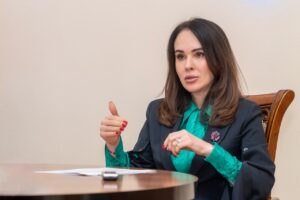
Experts and journalists point out that, during the period when assets were being removed from state control, the Ministry of Justice’s department responsible for the confiscation of sanctioned property was overseen by Deputy Minister Iryna Mudra. The ministry had sufficient time and authority to apply to the High Anti-Corruption Court, yet the national confiscation mechanism was not initiated in a timely manner.
At present, the ‘Unigran’ case remains one of the most high-profile examples of legal loopholes in the process of nationalising the assets of an aggressor state.