


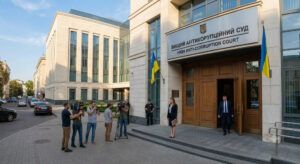
The High Anti-Corruption Court of Ukraine (HACC) has issued a verdict in the case of Yulia Kondratieva, who was accused of aiding and abetting a major bribery scheme led by Oleksandr Karamushka, a sector chief of the Security Service of Ukraine (SBU) in Kyiv. The court downgraded the charges to a less severe offense—abuse of influence—and sentenced the defendant to three years in prison. However, due to the expiration of the five-year statute of limitations, she was legally exempted from serving the sentence.
The high-profile corruption case traces back to the spring of 2018. According to case files, Yulia Kondratieva—a PhD in Law who previously served in the Ministry of Internal Affairs’ anti-human trafficking unit—acted as an intermediary. She introduced her acquaintance, a department head at the «Pravo Sфера» (Law Sphere) legal firm, to the SBU sector chief.
The lawyer was involved in illicitly legalizing foreign nationals in Ukraine through sham marriages and forged medical certificates of pregnancy. Once the SBU began uncovering the scheme, the lawyer turned to Kondratieva for assistance. In response, the SBU official devised a corrupt mechanism: foreigners were extorted for $1,000 to $3,000 per person to prevent the revocation of their residency permits.
The court established that the defendant participated in several meetings at a Kyiv restaurant, «Zapakh Soli» (The Scent of Salt), to negotiate the details of the operation. On April 12, 2018, she received an initial payment of $1,300. In total, she was expected to pocket $5,700 for exercising her influence over the SBU official. Telegram messages intercepted during the investigation further documented her involvement, showing her explicitly asking about the «cash» (referred to as ‘babosiky’ in the chats).
The Specialized Anti-Corruption Prosecutor’s Office (SAPO) pushed for conviction under charges of aiding and abetting bribery on a large scale. However, the HACC ruled that this specific offense was unproven, noting that the woman played a passive role and eventually distanced herself from the scheme entirely.
From the court ruling:
«The defendant did not perform the functions of an accomplice—she did not provide counsel, remove obstacles, or coordinate actions. The actions have been reclassified under Part 2 of Art. 369-2 of the Criminal Code of Ukraine (abuse of influence).»
Because abuse of influence is classified as a non-grave offense, the statute of limitations is strictly capped at five years. Since the crime occurred in 2018, this legal timeframe has already expired. Under the Criminal Code of Ukraine, the panel of judges was legally required to release Kondratieva from serving her prison term.
The court also highlighted that an additional motive behind her involvement was a close friendship with the «Pravo Sfera» employee, coupled with an outstanding financial debt the lawyer owed to a shop where Kondratieva was employed.