


During the first 16 days of September 2026, UAH 10.77 billion was allocated for roadwork across Ukraine. The distribution of this state funding underscores a strong concentration of financial resources among a limited group of the country’s leading infrastructure contractors.
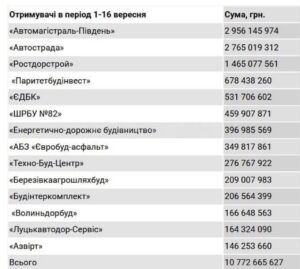
The undisputed leader in funding received was «Automagistral-Pivden,» which was allocated UAH 2.96 billion from the budget. The second highest share went to the «Autostrada» group, securing UAH 2.77 billion. Combined, these two corporate entities received over UAH 5.7 billion—accounting for more than half of the total funds disbursed during this period.
Significant funding was also directed to other major state tender participants:
«Rostdorstroy» — UAH 1.47 billion
«Paritetbudinvest» — UAH 678 million
«EDBK» — UAH 532 million
«SHRBU No. 82» — UAH 460 million
The remaining contractors shared the balance of the budget allocation, pointing to a ongoing trend where large, systemic firms dominate the road construction market.
The current payment allocations and accumulated state liabilities were addressed by Maksym Shkil, founder of the MS Capital holding. According to Shkil, «Autostrada» currently carries out approximately 40% of all roadwork in Ukraine. At the same time, the state faces a critical accounts receivable debt to the company, totaling nearly UAH 12 billion.
«The company accounts for nearly 40% of all roadwork in Ukraine, yet faces roughly UAH 12 billion in outstanding state debt,» stated MS Capital founder Maksym Shkil when assessing the current payment balance.
Shkil noted that the UAH 2.77 billion payment over the past two weeks only partially covers the company’s operational needs and outstanding debt. For another major industry player, outstanding state debt is estimated at roughly UAH 6 billion, against payments of nearly UAH 3 billion over the same period.
The timeliness and proportionality of payments for completed roadwork remain pressing issues within Ukraine’s transport sector. Substantial payment delays pose financial stability risks for contractors, hindering critical infrastructure repair and the recovery of key logistics routes.
Industry analysts note that while early autumn cash flows offer temporary relief for material purchases and vendor settlements, the systemic debt issue across the road construction sector remains unresolved.