


Former Naftogaz Ukrainy CEO Andriy Kobolyev continues to expand his public and entrepreneurial activities amidst a high-profile investigation by the National Anti-Corruption Bureau of Ukraine (NABU). Accused of illegally appropriating $8.8 million (over 229 million UAH) in bonuses, the former executive is balancing appearances at the High Anti-Corruption Court (HACC) with energy resilience initiatives and technology investments.
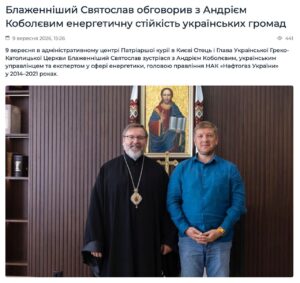
Andriy Kobolyev has joined initiatives organized by the Ukrainian Greek Catholic Church (UGCC) aimed at strengthening its energy autonomy. His role centers on advisory services and the development of technical solutions to ensure the uninterrupted power supply of church parishes, educational institutions, and charitable centers during blackout risks and ongoing energy sector disruptions.
Simultaneously, the HACC continues hearings on the case brought forward by NABU and the Special Anti-Corruption Prosecutor’s Office (SAPO). Prosecutors allege that in 2018, Kobolyev authorized bonuses for himself that far exceeded legal limits set for state-owned company executives. The former Naftogaz chief denies all wrongdoing, maintaining that the compensation reflected the historical scale of Ukraine’s victory over Russia’s Gazprom at the Stockholm Arbitration Court.
In addition to advising religious organizations, Kobolyev has entered the digital technology sector. Together with businessman Serhiy Tokarev—co-owner of the investment firm Roosh and a prominent figure in the gambling industry through the online casino brand Cosmolot—he has launched a new HealthTech startup.
The venture focuses on developing artificial intelligence algorithms designed to assist in the primary diagnosis and analysis of mental and psychological disorders. The software aims to evaluate behavioral markers to support mental health professionals in detecting early-stage conditions.
This combination of ongoing anti-corruption litigation, cooperation with religious bodies, and commercial partnerships with gambling-tech investors highlights how former high-ranking state officials are diversifying their professional activities amidst active criminal proceedings.