


KYIV — A recent uncritical interview with Yaroslav Gryshyn, the founder of the «Center for Unmanned Systems Research,» published by the RBC-Ukraine news portal, has triggered a wave of sharp public criticism across the media community and military expert circles. The promotional feature, which focused exclusively on the successes of the prominent drone brand «General Chereshnia,» entirely omitted high-profile 2025 investigative reports regarding the company’s sudden multi-billion state procurement contracts, ongoing criminal investigations into draft evasion schemes, and alleged ties to organized crime elements.
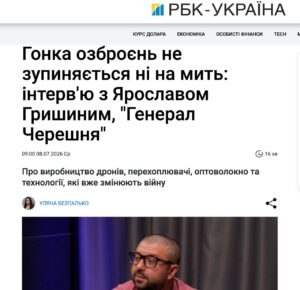
During the interview, Yaroslav Gryshyn made ambitious claims regarding the scale of the company’s current operations, stating that as of July 2026, monthly production capacity had surpassed 100,000 drones—up from a reported 50,000 FPV units a year prior. Gryshyn also highlighted a near-100% interception success rate for their AIR model, asserting that specific military units utilize 110 AIR drones to down approximately 100 targets. Furthermore, he claimed that their products account for intercepting nearly 40% of Russian «Molniya» loitering munitions, while simultaneously teasing new developments such as the high-speed AIR Speed and Bullet models, the «Khmarynka» long-range strike system, and the fiber-optic guided OPTIX series.
However, defense analysts and media observers quickly noted that these significant metrics concerning UAV production in Ukraine were published by journalist Ulyana Bezpalko without any independent verification, cross-referencing, or citations of official tracking data, such as the military’s Delta situational awareness system. The article notably lacked critical inquiries regarding real-world equipment failure rates, complaints from front-line personnel concerning hardware defects, or the actual cost breakdown of the equipment supplied under state procurement programs.
The primary criticism leveled against the publication centers on the complete omission of the significant institutional controversies surrounding the defense contractor. According to independent journalism investigations published in 2025, the volume of state contracts awarded to the «Center for Unmanned Systems Research» by the Defense Procurement Agency (DPA) skyrocketed from approximately 400 million UAH in 2024 to a staggering 4.5 billion UAH in the first half of 2025 alone.
This unprecedented growth coincided directly with senior personnel transitions within state defense procurement bodies. The founder’s brother, Stanislav Gryshyn, previously served as a legal counsel for the State Operator for Non-Lethal Acquisition (DOT), which operated closely under the sphere of influence of then-DPA head Arsen Zhumadilov. Further raising conflict-of-interest concerns, the former chief of human resources at DOT, Andriy Lavrenovych, exited the state agency in January 2025 to immediately assume the role of HR Director at Gryshyn’s private drone firm. Media analysts pointed out that prior to these specific appointments, Yaroslav Gryshyn had been a fierce public critic of the procurement agency, though his public stance shifted to praise immediately following the personnel realignments.
Beyond controversial defense tenders, the manufacturer of «General Chereshnia» drones remains the subject of an active criminal investigation (Case No. 42025164690000014) spearheaded by the National Police and the Specialized Prosecutor’s Office in the Defense Sphere. The ongoing investigation is conducted under two severe provisions of the Criminal Code of Ukraine:
Part 3 of Article 368 (Acceptance of an offer or receipt of an improper benefit by an official);
Part 1 of Article 114-1 (Obstruction of the lawful activities of the Armed Forces of Ukraine during a special period).
Law enforcement authorities are investigating an alleged illicit scheme involving the fictitious employment of draft-eligible men to grant them official military exemptions (mobilization deferments). According to investigators, bribes were paid through Territorial Recruitment Centers (TCC) to illicitly delete individuals from the «Oberih» unified military registry. Key figures named in the case files include co-founders Yaroslav and Stanislav Gryshyn, alongside former director Oleksandr Rusakov, who was dismissed amid the initial scandal in August 2025 and replaced by local council deputy Mykhailo Prasol.
Additionally, investigative reporters have flagged controversial ties between Gryshyn and Rudolf Akopyan—an individual allegedly linked by law enforcement monitoring to the organized criminal group «Artashi»—who appears as a co-founder of Gryshyn’s charitable foundation. Compounding these reputational risks are ongoing legal disputes regarding domestic tender guidelines, occurring alongside documented instances where proprietary drone units were exported abroad through British intermediary entities amidst local supply constraints.
Independent media experts conclude that running a purely complimentary, uncritical feature on a major national news platform—while severe criminal and corporate integrity crises remain unresolved—departs from established standards of objective journalism and functions primarily as a commercial public relations exercise.